
Most podcasts for dads sound like a parenting seminar. Experts with credentials. Frameworks with acronyms. Advice delivered from somewhere above you, not next to you.
That’s not what Guys Being Dads is. And that’s kind of the whole point.
How It Started
Two best friends. Post-college guys who never really stopped talking. Adam Kunes and Ben Petchel go back. Way back. These are guys who ran a travel company together called Have Fun Do Good. They’ve been stuck on mountains in Costa Rica together. They pulled someone out of the water at Lake Powell. They’ve guided groups through Zion, Bryce, and Yosemite.
When you’ve navigated that kind of stuff with someone, conversation comes pretty naturally.
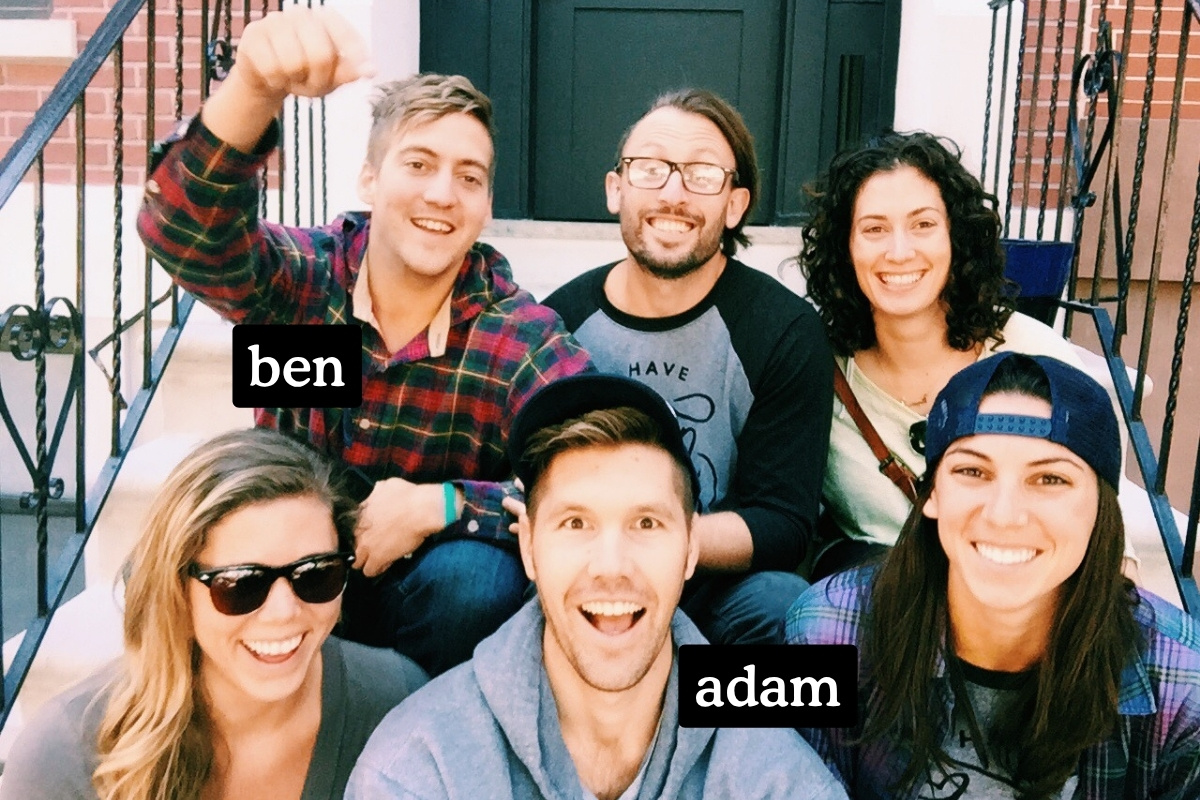
The First ‘Have Fun Do Good’ Experience
When they finally started recording, Ben was a dad-to-be. Adam was expecting his third kid. No agenda. No content calendar. No vision document. Just: we already have this conversation every week anyway. What if we hit record?
Worst case, nobody listens and they still got to catch up. Best case, something comes from it. Never know. That’s the whole origin story. There isn’t a more complicated version.
What It Actually Sounds Like
Raw. Not raw in a produced, aesthetically-intentional way. Actually raw. The kind of conversation that happens in a car on the way somewhere, or at the end of a long week when you finally have a minute to breathe and call your friend.
They talk about what they’re going through. Business. Fatherhood. Trying to be present when your head is somewhere else. Trying to show up for your family when you’re also trying to build something. The tension between the two. The moments when you get it right. The moments when you don’t.
No filters. No scripts. No expert panel. Just two guys being dads.
Why We Think There’s a Gap Here
Most content for dads is aimed at the problem. Here’s how to be more patient. Here’s how to be more present. Here’s a five-step framework for a better morning routine.
That’s all fine. We do some of that too.
But Guys Being Dads is aimed at something different. It’s aimed at the feeling of being a dad right now, in real time, while you’re also a person with a career and friendships and ambitions and a brain that doesn’t stop running just because you walked in the front door.
That version of fatherhood doesn’t get a lot of airtime. The messy, unresolved, still-figuring-it-out version. The one that doesn’t have a neat takeaway at the end of each episode.
We think a lot of dads live in that version. We know we do.
We’re 13 Episodes In
Thirteen episodes. Over 6,000 plays across Spotify and Apple Podcasts. For a show that started with zero marketing budget, zero audience, and nothing more sophisticated than two friends and a record button, we’ll take it.
More importantly, the feedback from the guys listening has been consistent. It feels like a conversation they want to be part of. It sounds like something real. It doesn’t feel like content.
That’s what we were going for.
Who It’s For
If you’re a dad who’s also trying to build something, whether that’s a business, a career, a body, a marriage, a life worth being proud of, this one is for you. If you want polished production and expert interviews, there are plenty of good options out there for that.
If you want two real guys talking honestly about what it’s actually like to be a dad and a person at the same time, come hang out with us. New episodes are on Spotify and Apple Podcasts. Search Guys Being Dads and you’ll find us.
Drop us a review if you like what you hear. It helps more than you know.
Join the Family


Father’s Day is a good time to stop and ask the question we don’t ask enough.
Not “what are you getting for Father’s Day?” Not “what’s your parenting philosophy?” Just: what does fatherhood actually look like for you right now? The good stuff. The hard stuff. What your kids have taught you. What you’d tell a new dad if you had one minute with them.
We asked our community. Dads from across the country answered.
Here’s what they said.
The Favorite Parts
We could have predicted some of these. We couldn’t have predicted all of them.
Nick Cook from Durham, NC, a graphic designer and dad to a 2.5-year-old son, put his right at the top: “Getting to embrace my inner child and be silly with my son. His laugh is contagious.”
Devon Garcia from Portland, OR, a Solutions Engineer at Slack whose daughter is eight months old, described it as “a free jolt of pure joy and dopamine from a simple laugh.”
Same feeling. Different words. Dad after dad came back to this one. The laugh. The specific, irreplaceable laugh of your specific kid.
Casey Stevens from Columbus, OH, who has a six-year-old and two-year-old boy/girl twins, described coming home from work to “the pitter patter of tiny feet racing to the door” and hearing “Daddy’s home.” He’s not alone. That sound came up in multiple forms across the responses.
Andrew Vossler from Charleston, SC, an executive coach with four kids ranging from five months to six years, described experiencing ordinary things as brand new again: “They didn’t know churros existed. The other day we went out on a mission to find and enjoy churros. Their minds were blown.”
Austin Bergstrom from Charlotte, NC, a mortgage loan originator with a 16-month-old daughter, said it simply: “How curious she is, and how much she loves us right now. All she wants to do is be outside, play, and be around us.”
And then there’s Jon Harris from Knoxville, TN, who has a unique vantage point on the whole thing. His son is 25. His daughter is 23. His youngest daughter is 19 months old. He became a dad again at 46, and he’s not taking any of it for granted.
“Every day she learns a new word, discovers something new, or finds a reason to laugh. I don’t take any of the so-called little things for granted.”
A second chance to do it with full awareness of how fast it goes. If that’s not a Father’s Day story, we don’t know what is.
The Hard Parts
Nobody pretended it was all churros and contagious laughs.
Nick Cook went straight for it: “Potty training, hands down. It is not for the faint of heart.”
Chris Reed from Phoenix, AZ, a customer success manager with a two-year-old and another baby due in November, named what a lot of dads feel but don’t always say: “Balance and patience. I want to do the best I can in so many things, but that can cause stress that eats away at other parts of my life.”
Austin Bergstrom said it differently but landed in the same place: “Always being on the go and rarely having my own time. Every day is a constant battle of getting all my work done to be able to spend time with my wife and daughter.”
Taylor Marton from Woburn, MA, a stay-at-home dad with a three-year-old and a newborn, described “managing the intense three-year-old mood swings and not letting his emotions dictate my emotions.” Anybody who has spent time with a three-year-old knows exactly what he means.
Luke Lasiloo from Flagstaff, AZ, a warehouse manager at a food bank with a two-year-old, got honest about something a lot of dads feel but rarely say out loud: “He is really attached to mom right now and only wants mom. It hurts my soul every time. But once I rip him away and it’s just the two of us, things are fantastic. It’s a real battle to not want to check out and melt into the background.”
That last sentence. That’s the one.
Christian Thorndike from Greenville, SC, an attorney with two boys ages two and three, is currently solo parenting for five weeks due to a family medical situation: “When stress, sickness, trying to be a good parent, work, and setting boundaries all combine, it becomes a bit overwhelming. But I’d rather have the bad days with them than days without them.”
And Rob Hogan from North Georgia, a forensic accountant whose daughter is 11, described the first moment in his parenting journey where he genuinely felt out of his depth: navigating puberty with his daughter. “It doesn’t matter how many books I read or women I talk to. I will never understand the emotional and physical changes she’s going through. It’s the first time I’ve felt genuinely ill-equipped to help her.”
There’s no hack for that one. Just showing up.
Join the Family
What Their Kids Have Taught Them
This was the section we weren’t fully prepared for.
The answers came in different words. And almost all of them said the same thing. Slow down.
Taylor Marton: “They’ve taught me to slow down and not rush so much. Our society is always in such a hurry to do everything, and my toddler has really challenged me to slow down and not make everything a rush.”
Jon Harris: “My older kids taught me that the years fly by. My youngest reminds me not to rush through them. She wants to stop and look at bugs, throw rocks in the creek, and dance to the same song over and over. Most days, she’s right.”
David Case from Edmond, OK, a forklift driver with a one-year-old: “She’s taught me to slow down and enjoy the moments. To really pay attention to life’s moments.”
Christian Thorndike: “Being present and enjoying even the smallest things in life.”
Stan Navrude from Overland Park, KS, a retired pharmaceutical professional whose sons are now 34 and 30, offered the long-view version: “Patience. I find myself emulating them at times.”
Brandon Jackson from Northeast Pennsylvania, an ESG reporting controller with a two and five-year-old: “Kids are a mirror, and I need to lead by example.”
Luke Lasiloo: “Gratitude. Hearing his little voice say ‘thank you’ every time you hand him something makes you really step back and look at what’s really important.”
And Rob Hogan’s 11-year-old daughter keeps him honest in the most direct way possible: “She will call me out if I try to preach something I don’t practice or if I’m not living up to my commitments. It’s a good reminder that we are what we do, not what we say.”
Chris Reed from Phoenix distilled it to one line: “Even the simplest things can be fun and bring a smile.”
What They’d Tell a Brand New Dad
This is the part we’ll be coming back to.
Nick Cook: “Be kind to your partner, be kind to yourself. The early days are a blur, but patience, teamwork, and a sense of humor will get you through.”
Devon Garcia: “No one has it completely figured out. There’s a lot of knowledge out there, but we’re all in it together of not knowing what we’re doing. Advice is take or leave. You have to tinker and try things, and that’s the fun part.”
Chris Reed: “Find community. It’s okay to be bad at this, it’s your first time. Communicate with your partner.”
Mike Tarnovsky from Marblehead, MA, a software sales professional with a 2.5-year-old son and a 2.5-month-old daughter: “This too shall pass. No matter the hardest days you have, your kids will do the smallest thing that makes you laugh and everything is forgotten. Also, don’t forget about your wife. Get her flowers or coffee on a random day of the week. She’ll appreciate it more than you’ll ever know.”
Taylor Marton: “Give yourself, your kids, and your partner lots of grace. We are all trying to be the best parents and kids we can be. No one is perfect.”
Brandon Jackson: “The clichés are true. Enjoy the little things, they grow up fast. Give your kids, your partner, and yourself some grace.”
Casey Stevens: “The days are long but the weeks are short. Time flies. Stop to take a moment and enjoy these days.”
Christian Thorndike: “Days are long, years are short. You don’t realize when you’ve done something for the last time until it’s really gone, like rocking the kid to sleep. Don’t rush it, no matter how difficult the days are.”
Dakota Carter from Birmingham, AL, a maintenance mechanic who is raising a 14-year-old nephew and has a 13-month-old daughter: “Don’t rush anything. Don’t rush to have kids. Don’t rush through the newborn stage. Don’t rush the moments that feel insignificant. In my experience, that’s where I’ve had the best conversations.”
Andrew Vossler from Charleston said something we think every dad needs to hear: “Do it in a way that is authentic to you and your partner. And do it with a larger community. Family, friends, church, neighborhood. I believe strongly we are not designed to parent in silos.”
Jon Harris, with 25 years of fatherhood behind him and a 19-month-old in front of him: “You don’t have to be perfect. You just have to keep showing up. The ordinary moments are the ones you’ll miss the most. Be there for them.”
Rob Hogan: “Get a day planner and use it as a journal. Take a few minutes every day to jot down a couple of notes. I’ve been doing this for a while and it’s amazing to look back and see moments that made an impression at the time. I know it’s cliché to say they grow up fast, but this has been one of the best pieces of advice I’ve ever received.”
And our favorite of the whole thread, from Chris Rodinsky, a therapist in California with two kids ages one and two: “Be the pier, not the PA system. Kids and wives need somewhere safe for their emotional waves to land. Your relationship is the pier. Your voice is just the PA system. Never confuse the two.”
What We Took From All of This
Different dads. Different cities. Different jobs, different ages, different stages of the fatherhood journey from eight months in to 35 years deep.
And the through line across every single response was the same.
The little moments are the big moments. You don’t know which ones will matter until they’re gone. Slow down. Be present. Give grace to everyone in the house, including yourself.
That’s not a parenting philosophy. That’s hard-won wisdom from men who are in it every day, figuring it out in real time, doing their best with what they have.
Happy Father’s Day to every dad in this community. You’re doing better than you think!
This one was making the rounds. And for good reason.
Eric Church, country star and proud Tar Heel, gave the commencement address at UNC and the internet couldn’t stop talking about it. So we watched it. And somewhere in the middle of it we realized he wasn’t talking to graduates in caps and gowns. He was talking to us.
The whole speech is built around a guitar. Six strings that, when tuned properly, make a chord that’s full and resonant and true. He walks through each one. And if you’re a dad watching it, each one lands somewhere specific.
Here’s what it felt like to watch it through that lens.
String One: Faith
Church calls faith the low E string. The foundation. The thing that holds everything else in tension and in tune.
He’s not talking about religion as a checkbox. He’s talking about your operating system. What you actually believe about what life is for. What holds when everything else shakes.
For dads, that’s the invisible string. Your kids don’t see it directly. They feel it.
They feel it in how you talk about people who wrong you. Whether you keep your word when it costs you something. How you handle the moment when the plan falls apart, the deal dies, the diagnosis comes back bad.
Nobody gives you applause for the ordinary faith. The one more story at bedtime. The game you showed up to when you had a hundred other things to do. The apology you offered first even when you were exhausted and probably right.
But that’s the string everything else rests on. And if it’s loose, the whole chord suffers.
String Two: Family
Church tells the graduates they’re about to get busy in ways that feel important. And that family is almost always the first string to slip out of tune.
Every dad knows that pull. One more email. One more call. One more thing that feels urgent. And your kid walks in with a ball or a book and you have to choose between what feels important right now and what actually is.
The world notices the business you build. The promotions. The milestones. It doesn’t notice the car line. The science project at 9:30pm. The phone you put face down so you could actually listen.
Those are the moments that tune the family string. And those are the moments your kids carry with them long after they’ve forgotten what you did for a living.
Church doesn’t frame it as guilt. He frames it as an invitation. The work of fatherhood is constant retuning. You slip out. You come back. You adjust. That’s not failure. That’s the job.
Join the Family
String Three: Marriage
Church maps the heart of the chord to your partner. Not a fairy tale version. The real one. Shared values. Showing up. Companionship over decades.
Here’s the part dads need to hear: your kids are watching how you treat their mom every single day.
They’re learning what love looks like when the camera’s off. How disagreements get handled. Whether affection survives stress. Whether two people actually choose each other or just coexist.
The greatest thing you can give your kids isn’t a perfect marriage. It’s a resilient one. One where they see apologies, laughter after a hard week, and two people consistently choosing each other. That’s the model they carry into their own relationships.
Your marriage and your fatherhood aren’t separate instruments. It’s all the same guitar. One string out of tune affects the whole chord.
String Four: Ambition and Resilience
Church puts ambition and resilience on the same string because they live in tension. He tells graduates the world has enough drifters. Want things. Go after them. But expect to get broken, and learn how to get back up.
That’s where a lot of dads live every day.
Ambition looks different after you have kids. It’s less about proving something to strangers. More about building something your family can actually stand on. More about modeling what it looks like to chase something without losing who you are in the process.
But resilience is where the real lessons land.
Your kids don’t just see what you achieve. They see how you respond when you lose.
The promotion that went to someone else. The business that hit a rough patch. The plan you were certain about that fell completely apart.
Do you spiral? Do you numb out? Or do you grieve honestly, adjust, and keep moving?
Church has a line about being stronger at the broken places. Every dad knows this. Your kids will learn more from how you handle your losses than from your highlight reel. They’ll remember whether you kept showing up.
String Five: Community
One of Church’s sharpest lines is his warning about becoming globally visible and locally invisible.
He means social media. The obsession with being seen by people who don’t actually know you. Building an audience while the real people in your life get the leftovers.
For dads, that one stings a little.
It’s too easy to share the photo from the game instead of actually watching the game. To talk about being a present father online while spending more time on your phone than on dinner. To build a public version of your life that looks engaged while the actual people in your house get whatever’s left at the end of the day.
Community for Church means planting yourself somewhere. Being known. Knowing others. For a dad that means learning the names of other parents. Showing up to the same places consistently. Building a network of people who will actually call you when things go sideways.
Our kids are growing up in a world where you can have thousands of followers and feel completely alone. We can show them something different.
String Six: Individuality
The last string is individuality. Church’s argument is simple. The world doesn’t need another cover song. It needs an original.
We heard that two ways as dads.
For ourselves: there’s enormous pressure to perform the “right kind” of fatherhood. The polished version. The one that matches what you see online. But our families don’t need a copy of someone else’s dad. They need us. Fully ourselves. Flawed, honest, present.
For our kids: each one of them is a song that already exists. Our job is not to rewrite them into the genre we prefer. Our job is to steward who they actually are. Notice what lights them up. Let them try and quit and try again. Defend their uniqueness when the world tries to flatten it.
Church’s call to protect your own voice is also a call to raise kids who know theirs.
The Chord We’re All Trying to Play
By the time Church picked up his guitar and brought it all together, we weren’t watching a commencement speech anymore. We were sitting with a framework for fatherhood.
Six strings. Faith holding everything together. Family that knows they’re chosen. A marriage that’s imperfect but loyal. Ambition that builds and resilience that doesn’t quit. A community where you’re actually rooted. And individuality, yours and your kids’, that doesn’t apologize for being original.
Our kids aren’t listening to what we say as much as they’re hearing the music of how we live.
Tune the strings. Play the chord. Make it something worth handing down.
Go watch the speech. You’ll be glad you did.