
We’re always looking for stuff that isn’t junk.
That’s genuinely the bar. Not educational in a flashy marketing sense. Not a toy that ends up in the corner after 20 minutes. Something that actually holds their attention, makes them think, and doesn’t make us feel like we wasted money on more plastic.
KiwiCo cleared that bar. Here’s what happened.
What We Got
We picked up subscriptions for both boys. Seven and four (almost five).
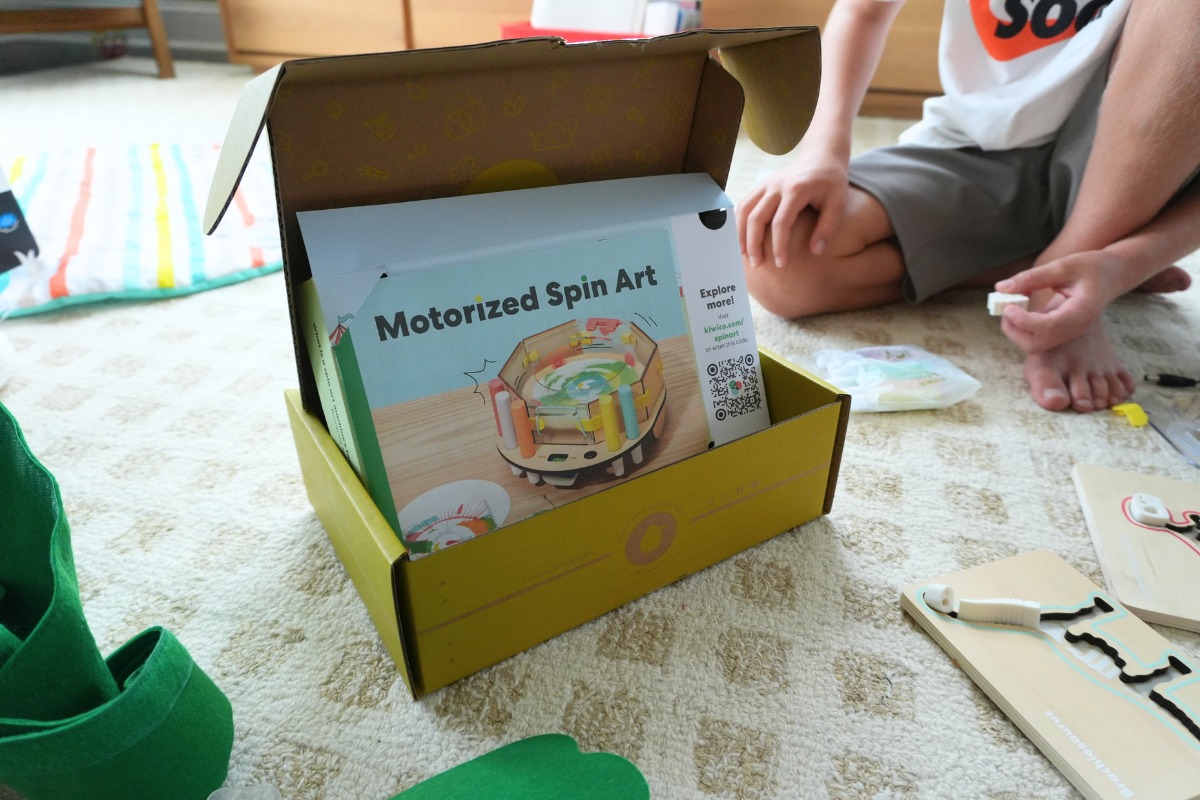
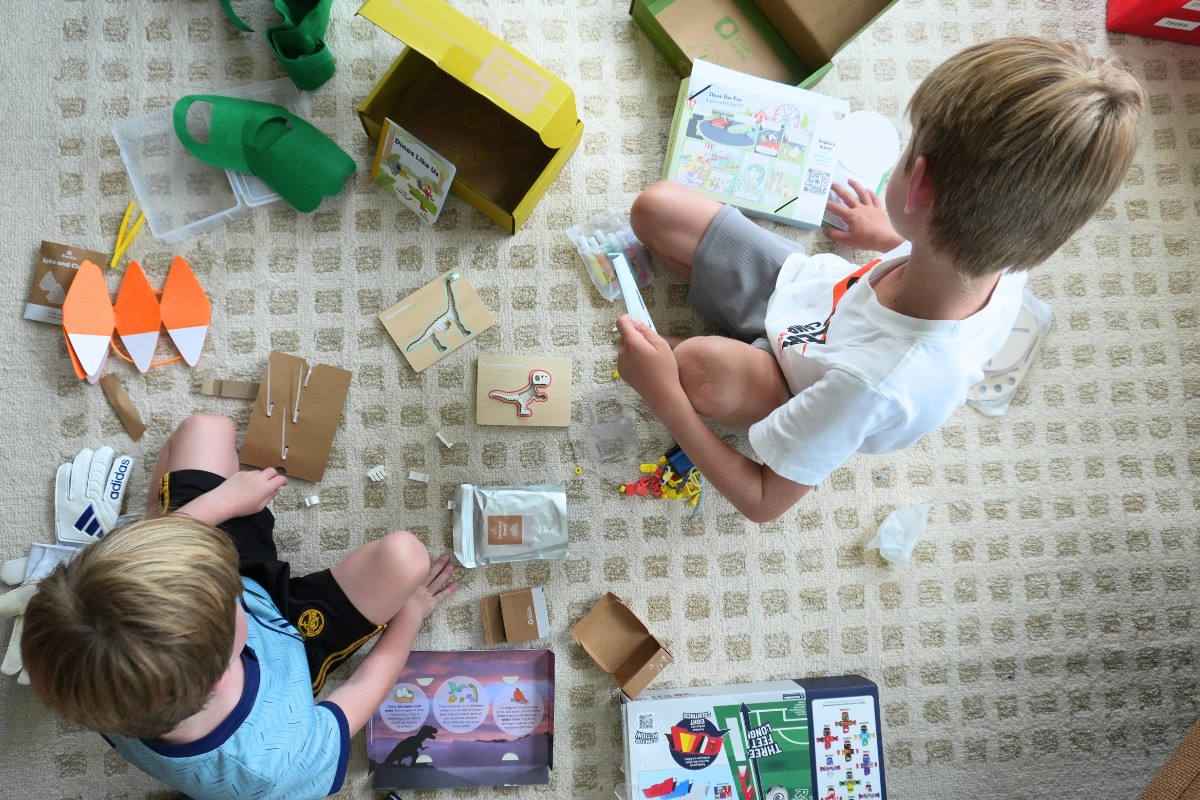
For our four-year-old we went with the Koala Crate, which is the ages 3 to 4 box. He got a dinosaur dig kit where you excavate little figures out of sand. For our seven-year-old we went with the Kiwi Crate, which runs ages 5 to 8. His was the Motorized Spin Art kit. He built the motorized device himself, loaded it up with paint, and let it rip. The result was this kaleidoscope-style artwork he made from scratch. Think spinning, color, and a finished piece he actually created himself.
Both boxes arrived with everything included. No running to the store for supplies, no missing pieces, no printing instructions off the internet. Everything was in there.
How It Actually Went
We handed them the boxes and mostly got out of the way.
That’s the honest version. We weren’t hovering, we weren’t co-piloting, we weren’t saving anyone from frustration every five minutes. They just did it.
Our seven-year-old was locked in. He built the motorized device, figured out the mechanics, loaded it with paint, and came back with this wild swirling piece of art he made himself. It wasn’t a participation trophy project. He built something real, it worked, and the result was genuinely cool. He wanted to show everyone in the house.
Our four-year-old liked his too, though here’s an honest note: if your kid is on the older end of an age bracket or running a little ahead developmentally, size up. We probably should have gone with the 5-to-8 box for him. The dinosaur dig was a little too quick for where he’s at right now. He still enjoyed it, but he was through it faster than we expected. We’ll go up a level on his next one.
That’s not a knock on KiwiCo. That’s just good advice for dads making the call: when in doubt, go up an age bracket. You know your kid.
Why We’re Keeping the Subscription
For $30 a month this is genuinely one of the better line items in the budget.
Think about what $30 normally gets you. A toy that breaks in a week. A game that loses half its pieces. Something with batteries that makes noise for six months straight. Or in this case, a curated box that shows up at the door, keeps the kids occupied for a solid stretch, gives them something they actually made, and sets them up excited for what comes next month.
Both boys are already asking about the next box. That’s the real tell.
What KiwiCo Actually Offers
For dads doing the math on which box to get, here’s the quick breakdown:
Koala Crate (ages 3 to 4): Hands-on learning for preschoolers. Good starting point but size up if your kid skews advanced.
Kiwi Crate (ages 5 to 8): Science, art, and engineering activities. This is the sweet spot for most elementary-age kids and the one we’d recommend most confidently.
Atlas Crate (ages 6 to 11): Geography and culture focus. Each box explores a different country with STEAM projects tied to the theme. Great if your kid is into travel or learning about the world.
Tinker Crate (ages 9 to 14): More advanced STEM. Build and engineering focus for kids who want to go deeper.
Eureka Crate (ages 12 and up): Engineering and design for older kids and teens. This one runs into adult territory, which is actually a nice detail.
Every subscription includes free shipping. Prices range from roughly $17 to $30 per month depending on which crate you pick and whether you go monthly or annual. Annual is obviously the better deal if you’re planning to stick with it, which after this first round, we are.
Our Honest Recommendation
If you’re a dad looking for something different to give your kids that isn’t more junk, KiwiCo is worth it.
It’s not a screen. It’s not passive. It’s something they build with their hands and walk away from with a finished product they made. That combination is increasingly hard to find at any price point, let alone $30 a month.
Our boys loved it. We’re keeping both subscriptions. And next month we’re sizing up the four-year-old.
Check out KiwiCo here and use the age guides to pick the right crate for your kid. Click through our link and you will get 50% off your first box. When in doubt, go one bracket up.
We paid for our KiwiCo subscription ourselves. This post contains an affiliate link. If you sign up through our link, you will get 50% off your first box.
Join the Family


We were listening to My First Million with Sam Parr and Shaan Puri recently and the topic of daily affirmations for kids came up.
The idea was simple: have your kids repeat certain phrases every morning. Things you want hardwired into how they see themselves before the world gets a chance to tell them otherwise.
It stuck with us. So we went down the rabbit hole.
Is this actually a thing? What does the research say? And what should dads be teaching their kids to say to themselves every day? Here’s what we found.
Why This Isn’t Just Feel-Good Fluff
The concept is simple. Kids are in a critical wiring period. What they hear repeatedly, especially from themselves, gets encoded into how they see the world and their place in it. Negative self-talk becomes a self-fulfilling prophecy. Positive self-talk, repeated consistently, rewires the internal narrative.
Words are programming. The question is who’s doing the programming.
Right now it’s a combination of their environment, their friends, social media, and whatever their brain decides to chatter about at 2am. Most parents leave this entirely to chance. You don’t have to.

What the Science Actually Says
This isn’t feel-good fluff. The research is real and it’s consistent.
A study published in Social Cognitive and Affective Neuroscience found that self-affirmation activates the part of the brain tied to self-worth and emotional regulation. We’re talking about measurable, physical changes in brain activity from saying positive things about yourself.
Research from the University of Pennsylvania showed that repeating self-affirmations produces physical changes in brain regions associated with self-processing. The brain literally rewires around the messages it receives consistently.
A study in Child Development found that even brief self-affirmation exercises helped teens feel more capable and improved their school performance over time.
Research shows that daily repetitions of positive affirmations in children help them develop stronger self-esteem, increase psychological wellbeing, and significantly improve their educational performance and motivation.
The mechanism isn’t complicated. Kids develop their belief systems early. What they hear from their environment, their parents, their peers, and crucially from themselves, gets baked in. The affirmations work because they give kids a competing voice to the negative self-talk that naturally creeps in. They build the internal narrative on purpose instead of letting it form by accident.
The Window You Have Right Now
Here’s the part that creates urgency.
Licensed family therapist Kelly Oriard, co-founder of Slumberkins, puts it plainly:
“When children use positive phrases about themselves, it helps shape and strengthen their own inner voice that will be with them a lifetime.”
Their lifetime. Not just their childhood.
The inner voice your kid develops before age ten is going to follow them into every job interview, every hard conversation, every moment of self-doubt they face as an adult. You have a window right now to help shape what that voice sounds like.
Most parents leave this entirely to chance.
What to Actually Have Your Kids Say
The research is clear that affirmations work best when they’re specific, age-appropriate, and repeated consistently. Not a random list. A small set of phrases your kid says every day until they believe them.
Here’s how we’d think about building a short list for your kid based on the areas that matter most.
On capability and resilience: “I can do hard things.” “I am braver than I feel.” “When I fall down I get back up.” “I figure things out.”
On identity and self-worth: “I am loved.” “I am enough.” “I matter to my family.” “I am proud of who I am.”
On mindset and growth: “My brain gets stronger every day.” “Mistakes help me learn.” “I don’t give up.” “I keep going even when it’s hard.”
On confidence and courage: “I am brave enough to try.” “I believe in myself.” “I can handle whatever comes.” “My voice matters.”
The research suggests keeping the list short. Three to five phrases is better than twenty. The goal is for them to genuinely internalize these, not recite a script.
How to Actually Make It Happen
The biggest reason parents don’t do this is it feels weird to start. Here’s how to remove the friction.
- Make it a morning routine anchor. The morning is the highest-leverage moment. Before school, before devices, before the day has a chance to put its own spin on things. Even 60 seconds of affirmations during the drive to school or at breakfast changes the internal setup for the whole day.
- Do it with them. Don’t hand your kid a list and tell them to recite it alone. Say it together. You modeling it removes the awkwardness and adds the weight of your voice alongside theirs. Some dads go first. Some do it call-and-response style. Find what works for your kid.
- Start young, keep going. Research shows you can start this with toddlers. Simple phrases work for young kids. “I am brave. I am kind. I am loved.” Three-year-olds can say these. And the earlier the internal voice gets shaped in a positive direction, the longer it runs.
- Let them own it as they get older. The best affirmations are ones your kid chooses themselves. Around age six or seven, ask them what they want to believe about themselves. Write those down. Those will hit differently than anything you hand them because they came from inside.
- Consistency over intensity. Every day for two minutes beats once a week for twenty minutes. The research is clear that repetition is what produces the neurological change. Build the habit small and protect it.
The Bottom Line
Your kid’s inner voice is being formed right now. Either by design or by default.
The affirmation piece isn’t soft parenting. It’s intentional parenting. It’s recognizing that the words your kid repeats to themselves every morning become the beliefs they operate from for the rest of their life.
The kids who grow up with a strong, positive internal narrative are harder to rattle. More resilient. More willing to try things. Better at getting back up.
It starts with 60 seconds in the morning. Start tonight.
The onesie that fit last week doesn’t fit today.
You didn’t notice it happening. You were just living. Doing the feeds, the burp, the 3am shuffle to the crib and back. And then one morning you go to snap it and something’s off and you realize: he grew out of it. Sometime in the last seven days, while you were just trying to get through the week, something changed.
That’s kind of how all of it goes.
The Trap Nobody Warns You About
When you have a newborn, it’s almost impossible to imagine them walking.
They can’t hold their own head up. They need you for everything. The version of them that runs through the house and has opinions about dinner feels like science fiction.
So you don’t plan for it. You just survive the stage you’re in.
And then suddenly they’re crawling and you haven’t baby-proofed anything. Then they’re walking and you’re scrambling. Then they’re starting school and you’re realizing you never thought about what that transition was going to feel like.
Then they’re a teenager and you’re wondering how you got here and whether you built the kind of relationship that’s going to survive the next few years.
None of it sneaks up on you slowly. It all arrives faster than you expected, every single time, even after you’ve been told a hundred times that it will.
This Isn’t About Rushing It
To be clear: we’re not saying sprint through the stages. We’re not saying wish it away or skip the hard parts to get to the good parts.
The opposite.
The point is that the dads who think a little ahead, who have some loose sense of what’s coming and what they want to be building toward, tend to be more present in the current stage. Not less. Because they’re not just reacting. They’re playing a longer game.
There’s a difference between rushing and being intentional. Rushing is wishing this stage was over. Being intentional is enjoying this stage while quietly keeping one eye on who your kid is becoming and what they’re going to need from you next.
What Thinking Ahead Actually Looks Like
It doesn’t have to be complicated. It’s not a spreadsheet.
It’s more like a loose awareness. An occasional question you ask yourself: what’s coming next, and am I ready for it?
When they’re a baby, what’s coming next is mobility. At some point this child who is currently a potato is going to move. Then walk. Then run. Then open every cabinet in the kitchen while you’re in the shower. The dads who think about this a little bit ahead of time aren’t caught completely flat-footed when it happens.
When they’re a toddler, what’s coming next is language. Real, full sentences. Opinions. Questions you don’t know how to answer. The dad who’s been having one-sided conversations with his kid for two years, narrating everything and asking questions even without answers, has laid some groundwork for this.
The dad who’s been handing over the iPad every time things got quiet hasn’t.
When they’re in elementary school, what’s coming next is the formation of their identity. They’re going to start caring what their peers think. They’re going to start forming their own sense of who they are.
The dad who’s been paying attention to what lights his kid up, what they’re curious about, what kind of person they’re becoming, has something to work with. He can meet them in that.
When they’re a preteen, what’s coming next is the wall. The pulling away. The “I’m fine” when they’re clearly not fine. The dads who built the relationship in the earlier years, who logged the hours and the conversations and the side-by-side time, have something to draw on when things get harder.
The dads who figured they’d connect with their kid when they got older sometimes find that the door is a little more closed than they expected.
You don’t have to have all the answers for every stage. You just have to know it’s coming.
The Specific Thing Most Dads Miss
The physical stuff. Not emotional readiness. Physical readiness.
Your kid is going to get faster than you. Sooner than you think. The toddler you can scoop up with one arm is going to be a ten-year-old who can actually run. Then a teenager who can beat you in a sprint.
The dad who kept himself in some kind of shape, who built the habit of staying capable, can still keep up when it counts. Soccer sidelines, driveway races, hiking trails that get harder as the kids get more ambitious. The dad who let things go completely is sitting it out by the time his kid is actually old enough to really do things with.
This isn’t about vanity. It’s about availability. Being physically capable enough to show up for the stages ahead.
Join the Family
The Practical Version
Once a year, sit down and think about what stage your kid is entering in the next twelve months.
What’s going to change? What are they going to need more of from you? What conversations are coming that you haven’t had yet? What habits are you building right now that are going to carry into the next stage?
You don’t need to have it all figured out. You just need to not be completely caught off guard.
The parents who look back on their kids’ childhoods and say it went too fast are usually the ones who spent it all in reactive mode. Surviving each stage. Getting through the week. Looking up one day to find their kid is leaving for college and wondering how it happened.
It happened week by week. Day by day. The way it always does.
The Stage You’re In Right Now Is Worth Paying Attention To
That’s the other side of this.
If you’re always thinking about the next stage, you miss the one you’re standing in. The one that won’t come back.
The baby weight in your arms right now. The tiny hand that reaches for yours right now. The ridiculous three-year-old mispronunciation of a word that’s somehow the funniest thing you’ve ever heard right now.
Don’t rush through it to get to the good parts. These are the good parts.
Just don’t be so in it that you never lift your head and think about where it’s all going. Because it’s going somewhere. Faster than you think.
Stay present. Stay aware. Those two things aren’t opposites.
They’re the whole job.
We’ve built an impressive system for raising kids who are good at following instructions.
School teaches them to sit still, raise their hand, wait their turn, and get the right answer. Social media teaches them to perform for approval. Group chats teach them to read the room before they say anything. The entire architecture of modern childhood is quietly, constantly asking kids: what does everyone else think?
And we wonder why so many kids struggle with confidence.
Here’s what we believe: confidence isn’t a personality trait your kid either has or doesn’t have. It’s a skill. It’s built. And it’s built mostly at home, mostly by you, mostly through things you do and say in ordinary moments you don’t even realize are significant.
This is the guide we wish someone had handed us.
What Confidence Actually Is
Let’s get clear on the definition first because most people get this wrong.
Confidence is not the absence of doubt. It’s not the kid who never gets nervous, never questions themselves, never feels the sting of what other people think. That kid doesn’t exist.
Real confidence is the ability to act despite doubt. To move forward when you’re not sure.
To trust your own judgment enough to make a call and live with it. To feel the discomfort of someone’s disapproval and not let it determine your next move.
Psychology Today puts it simply: confidence is the ability to trust yourself, override anxiety, and step out with a strong stride in life into whatever you’re pursuing, whether that’s speaking up against a bully or giving a book report.
That’s the goal. Not fearlessness. Not arrogance. Self-trust.
And the research on how to build it is surprisingly consistent.
The Two Kinds of Kids (And Which One You’re Raising)
Psychologist Dr. Jim Taylor draws a line between two types of children.
Contingent children are dependent on others for how they feel about themselves. Independent children are intrinsically motivated to achieve. What you want to raise is a self-reliant child, one who is confident in their own abilities and able to do things for themselves.
The contingent kid is constantly scanning for approval. They check the room before they express an opinion. They modify themselves based on who’s watching. They’re exhausting to be because the emotional regulation is always outsourced.
The self-reliant kid has an internal compass. They know what they think. They can tolerate disagreement. They don’t need the room to agree with them to feel okay.
The difference between these two kids is not genetics. It’s not luck. It’s largely what happened at home between ages three and twelve.
Here’s how to build the second one.
Let Them Struggle. On Purpose.
This is the counterintuitive one that most parents get backwards.
Research shows that parents who are over-involved in an activity a child is doing, who take over, raise kids who don’t develop a sense of pride, adventure, and willingness to try new things.
Read that twice.
Every time you jump in to fix it, finish it, smooth it over, you are sending a signal. The signal is: I don’t think you can handle this. That signal compounds over years into a kid who genuinely doesn’t believe they can handle things.
Let them figure out the Lego before you help. Let them navigate the conflict with the friend before you call the other parent. Let them sit with the hard homework problem for fifteen minutes before you explain it. Let them feel the discomfort of not knowing and then watch them find their way through it.
The pride that comes from solving something difficult is one of the primary building blocks of confidence. You cannot give that pride to them. They have to earn it themselves. Your job is to create the conditions and then get out of the way.

Praise the Right Thing
Most parents praise results. Smart parents praise process.
Stanford psychologist Carol Dweck’s research has made this distinction famous for good reason. Kids who are praised for being smart become afraid of failing because failure threatens their identity. Kids who are praised for effort and process become willing to take on harder challenges because the challenge itself is the point.
The difference in practice is small but significant.
“You’re so smart” becomes “I love how hard you worked on that.”
“You’re such a good athlete” becomes “I noticed how you kept going even when it got hard.”
“That was easy for you” becomes “You figured that out. How did you approach it?”
Doubt is normal. It doesn’t mean your kid isn’t confident. Get specific and narrow down the area of doubt rather than seeing doubt as a sign of lack of confidence.
Think growth mindset: encourage children to ask for help and think about what they need to improve.
The goal is a kid who sees challenge as information, not as evidence of inadequacy. That shift starts with how you talk to them after every game, every test, every project, every attempt.
Answer the Why Questions
Kids start asking why around age three. Most parents get worn down by it fast.
Laurence Steinberg, a psychologist at Temple University specializing in adolescent development, says kids start to develop critical thinking skills right around when they begin asking why questions. It’s important that parents take the time, when they can, to answer those questions, because you don’t want a child to think it’s bad or wrong to ask.
The why questions are not annoying. They are your kid building the machinery they’ll use to think for themselves for the rest of their life. Every time you engage with a why question instead of shutting it down, you’re telling them their curiosity has value. Their thinking has value. Their judgment is worth developing.
Every time you say “because I said so” and close the conversation, you’re training them to stop asking and start complying. Compliant kids are easy to raise. They are also easy to bully, pressure, and manipulate because they’ve learned to defer to external authority rather than their own internal voice.
Answer the why. Even when you’re tired. Especially when you’re tired.
Teach Them to Disagree With You
This one takes some courage from the dad’s side.
When children challenge our authority, they begin to develop critical thinking skills. By questioning rules and seeking explanations, they learn to analyze situations, consider different perspectives, and evaluate the validity of rules, expectations, and instructions. This process cultivates independent thinking and helps children form personal opinions, values, and beliefs.
The kid who can look you in the eye and respectfully disagree with you is practicing one of the most important skills of their entire life. They are learning to hold a position under social pressure from the most powerful person in their world.
If they can do that with you, they can do it with the friend group telling them to do something stupid. They can do it with the internet. They can do it with the culture telling them who they’re supposed to be.
Create space for your kid to push back on your thinking. Ask them what they think about a decision you made. Tell them you might be wrong. Show them that changing your mind when you get new information is strength, not weakness. The family dinner table is a training ground for their entire future relationship with authority, pressure, and their own judgment.
Use it intentionally.
Join the Family
Talk About Bullies Differently
Most advice about bullies focuses on the bully. What to tell a teacher, what to do in the moment, how to stay safe.
That stuff matters. But the deeper work is building the internal architecture that doesn’t collapse when someone is cruel.
Here’s what that looks like in practice.
Separate their worth from the opinion. When your kid comes home and tells you someone called them something awful, your first instinct is to fix it. What they actually need is help separating the event from their identity. What that person said is data about that person. It is not data about your kid. That distinction has to be taught explicitly and repeated often because the culture is constantly telling them the opposite.
Normalize being disliked. This sounds harsh. It’s actually one of the most liberating things a parent can teach a child. Not everyone is going to like you. Not everyone is going to think you’re great. Some people are going to be actively unkind. That’s true now and it will be true at forty. The question is whether that reality has the power to determine how you feel about yourself.
One parent captured it perfectly when she told her daughter: you can’t please everyone. And not everyone is going to like you. But that’s okay. Her choice had value. Instead of worrying about what everyone else thought, her daughter needed to think about her own desires too.
Don’t rush to fix it. When your kid is upset about what someone did or said, the temptation is to solve it immediately. Call the school. Talk to the other parent. Make it stop. Sometimes those things are necessary. But before you do any of that, sit with them in it. Let them feel it fully. Ask them what they’re feeling and why. Ask them what they want to do about it. The processing is where the resilience lives.
Model how you handle your own critics. Your kid is watching how you respond when someone is unkind to you. When someone cuts you off and you lose it, when you spend dinner talking about what a coworker said about you, when you ruminate visibly about what someone thinks, you’re giving them a template. Give them a better one. Show them what it looks like to absorb a criticism, decide whether there’s anything useful in it, and move on without letting it take over the room.
Let Them Own Their Interests. All of Them.
Younger children especially are trying to assert their independence in ways that may come across as defiant or disorderly to some parents. But experts caution not to overreact or jump in to correct too quickly.
The kid who is passionate about something weird and specific and completely their own is building something important. They are learning what it feels like to care deeply about something regardless of whether anyone else cares. That internal relationship with their own interests is the seed of a self that doesn’t require external validation to exist.
Let them go deep on the thing nobody else at school is into. Don’t redirect them toward something more conventional. Don’t make them feel like their interests need to be justified or explained. The kid who knows their own mind about what they love is significantly harder to push around than the kid who is still trying to figure out what the group thinks is cool.
The Most Important Thing You Can Model
All of this circles back to one thing.
Your kid is building their model of how a person exists in the world primarily by watching you. How you handle uncertainty. How you respond to criticism. Whether you say what you actually think or perform what you think people want to hear. Whether you make decisions from your own values or from what the room will think.
Children learn by observing. Show them how to navigate social situations with empathy, clear communication, and respect. When they see you handle uncertainty with composure, they’re more likely to do the same.
Be the version of yourself you want them to become. Not the aspirational version. The real, daily, ordinary version. The one that shows up at breakfast and makes calls under pressure and handles it when someone is unkind and gets back up when something goes wrong.
That’s the curriculum. You’re the teacher.
Further Reading
If this resonates and you want to go deeper, a few resources worth your time:
- The Confidence Code for Girls by Katty Kay and Claire Shipman. Specifically for dads of daughters but the science applies broadly.
- Mindset by Carol Dweck. The foundational research on growth mindset and why how you praise your kids matters more than you think.
- How to Raise an Adult by Julie Lythcott-Haims. A former Stanford dean’s case against over-parenting and for raising kids who can actually function on their own.
- The Coddling of the American Mind by Greg Lukianoff and Jonathan Haidt. The cultural argument for why we need to raise more resilient, self-directed kids and what gets in the way.
Here’s the tension nobody warns you about.
You want to do things with your kids. Real things. Hikes that go somewhere. Trips that mean something. Weekends that don’t evaporate in front of a screen. You want them to grow up with a sense of the world and their place in it.
And then you actually try to do those things with your kids.
The baby needs a feeding every three hours. The toddler wants to stop and examine every single rock on the trail. The five-year-old has decided halfway up the mountain that their legs don’t work anymore. The eight-year-old is bored five minutes into anything that wasn’t their idea. The twelve-year-old is present in body only.
This is the honest version of adventuring with kids. It is not the Instagram version. It is not the version where everyone is laughing in matching jackets on a summit. It is the version where you are negotiating with a four-year-old about whether they need to use the bathroom before you get in the kayak.
But here’s what we also know. The memories stick. The hard ones especially. The time you pushed a little further than felt comfortable and something happened that none of you saw coming.
The summit that felt impossible until it wasn’t. The moment your kid realized they were capable of something they didn’t know they could do.
That’s worth chasing. You just have to know how to chase it at the right level for where your kid actually is.
Here’s the age-by-age guide for how to do it.

The Philosophy First
Before the ages, a framework that makes everything else work.
Meet them where they are, not where you want them to be.
The biggest mistake dads make when adventuring with kids is planning the trip they want to take and then dragging the kids along. A six-mile hike with 2,000 feet of elevation gain is a great hike for you. For a five-year-old it is a hostage situation.
The adventure has to be sized for them. Not dumbed down. Sized. There’s a difference. A great adventure for a four-year-old might be a half-mile trail to a waterfall. That waterfall is just as real as yours. The mud on their boots is just as satisfying. The sense of having gone somewhere and found something is exactly the same.
Let them set the pace whenever you can.
Kids who feel dragged through an experience don’t absorb it the same way kids who feel like they’re leading it do. Give them ownership. Ask them to navigate. Let them pick which fork to take. Let the trip slow down when something catches their attention.
Yes, this means you will spend twelve minutes looking at a caterpillar. The caterpillar is the adventure for them right now. Let it be.
Build the yes before you push the limit.
Every great adventure with your kid is built on a foundation of smaller ones that went well. The trust gets established in the easy miles. The resilience gets built in the slightly hard ones. The big stuff comes later, when they know you’ve got them.
Don’t skip the foundation. The summit can wait.
Babies and Infants (0 to 1 Year): You’re Training Yourself
Let’s be real about this stage.
The adventure is not for them yet. They won’t remember it. They have no preference about whether they’re on a mountain or in the living room. The world is enormous and confusing either way.
The adventure at this stage is for you. You’re training yourself not to disappear. Not to put the adventurous version of yourself in storage until the kids are older.
Because the dads who do that often discover that by the time the kids are old enough, the habit is gone.
This is the stage to figure out the gear. The carrier is everything. A good structured baby carrier, Ergobaby Omni, BabyBjörn Move, Osprey Poco, changes everything about what’s possible with a baby.
You can hike. You can walk the city. You can explore. The baby is along for the ride and generally happier than you’d expect because the motion and your body heat tend to put them straight to sleep.
Short hikes. Flat walks. Beach days. Farmers markets. Anything that keeps you moving in the world and gets you practiced at doing things with a small human attached to you.
The payoff comes later. The habit is being built now.
Toddlers (1 to 3 Years): The Chaos Stage
Toddlers want to do everything. They also can’t do most things. That gap is where the comedy and the frustration both live.
A toddler on a trail is not hiking. They are conducting a slow-moving scientific investigation of the natural world. Every stick. Every bug. Every puddle. Every pile of dirt that looks slightly different from the last pile of dirt. This investigation has no agenda and no timeline and it is entirely absorbing for them.
Your job is to protect the investigation without killing it.
What works at this age:
Short trails with big payoffs. A quarter mile to a creek. A half mile to a waterfall. Something they can see and touch and interact with at the end. Distance is irrelevant. Destination matters.
Water. Always water. A toddler near a creek or a beach or a puddle is a toddler who is completely occupied. If your adventure involves water in any form, you have bought yourself a minimum of 45 minutes of genuine engagement. Pack dry clothes and lean into it.
Let them walk until they can’t. Then carry them. The moment you force a toddler to keep walking when they’re done, you’ve lost them. Have a carrier or a good pack ready for the second half of anything.
Pack two of every snack. One for now. One for the meltdown that’s coming.
The expectation reset:
You will cover less ground than you planned. The trip will take longer than you expected. Something will go sideways. Plan for all of it and you’ll stop being surprised when it happens.
The metric for success at this stage is: did they have a good time? Did they see something cool? Did they go to sleep easily that night? That’s a win. Nothing else required.
Preschool and Early Elementary (3 to 6 Years): The Golden Age Begins
This is where it starts to get genuinely fun.
Kids in this range are capable of more than most parents give them credit for. They can hike legitimate distances when motivated. They can kayak in a tandem. They can camp and actually sleep. They can snorkel in calm water. They have energy that borders on supernatural.
The key is motivation. A motivated four-year-old will walk further than seems physically possible. An unmotivated one will lie down on the trail and refuse to move regardless of how much it embarrasses you.
Motivation at this age comes from a few places. A destination they can picture. A treat waiting at the end. A friend along for the ride. A story about the place you’re going before you get there. Their own gear that feels real and not like a toy.
What works at this age:
National parks are made for this stage. Junior Ranger programs give kids a mission. They collect badges, answer questions, do activities. The park becomes a game. We cannot overstate how much the Junior Ranger program transforms a trip for a kid in this age range.
It’s free, it’s everywhere, and it turns a passive spectator into an active participant.
Family camping at this age is genuinely one of the best things you can do. Not glamping. Not a cabin. Actual tent camping. Setting it up together, making fire, cooking outside, sleeping in a bag.
Something about sleeping outside does something to kids that is hard to explain and impossible to replicate anywhere else.
Give them a real job. Navigator. Photographer. Camp chef assistant. Fire tender under supervision.
Kids who have a job on the adventure are invested in the adventure.
Kids who are just passengers disengage.
Bikes and scooters extend their range dramatically. A kid who can barely walk two miles can cruise five on a bike. Rail trails and paved paths are underrated adventure infrastructure for this age group.
The thing to push gently:
Start introducing discomfort as something survivable. A hill that’s hard. Weather that’s not perfect. A day that doesn’t go as planned. How you handle those moments in front of your kid is some of the most important teaching you will ever do. Stay calm. Stay positive. Show them the problem-solving version of yourself.
They are watching everything.

Elementary School (6 to 10 Years): Level Up
Kids in this range can do real things.
Actual summits. Multi-day backpacking with the right planning. Whitewater in the appropriate class. Mountain biking on beginner to intermediate trails. Surfing. Rock climbing. The list of what’s accessible opens up dramatically.
This is also the age where the adventure starts to belong to them in a different way. They remember it afterward. They talk about it at school. They ask when you’re going back. The investment starts paying dividends that compound.
What works at this age:
Let them have a say in the planning. Not full control. A say. Show them the map and ask what looks interesting. Give them two or three options and let them vote.
When a kid chooses the destination, they arrive with ownership of the experience.
Introduce the concept of earning it. The best views come after the hardest climbs. The best campsites require the most miles. This is not a difficult lesson for kids to absorb at this age when it’s presented right. Hard things have good things on the other side of them. That lesson lives in the body differently than it lives in the head.
Gear matters more now. A kid with a real pack that fits them correctly, a headlamp they actually own, trekking poles if the terrain calls for it, a journal to record what they see, is a kid who feels like a real adventurer rather than someone being dragged through someone else’s adventure.
Multi-day trips become possible and powerful at this age. One night becomes two. A weekend becomes four days. The deeper you go, the more it changes them.
The tension at this age:
They have their own friends and interests now. Weekends fill up with parties and sports and sleepovers. The window for dad-led adventure starts to compete with other things for the first time.
Don’t cede the ground. Protect the trips. Put them on the calendar. Let them be the thing the family does, not the thing that gets sacrificed when something else comes up.
Tweens (10 to 13 Years): The Critical Window
Something shifts around ten or eleven.
They become self-conscious. They start caring what their peers think. The wide-eyed openness of the elementary years gets a little more guarded. Fatherhood in general gets more complicated during this stretch.
But here’s what we know from the dads who’ve navigated it: the ones who stayed consistent with adventure during these years came out the other side with something real. A through-line. A shared language with their kid that never fully went away even when everything else felt distant.
Adventure at this age works best when it respects their growing autonomy.
What works at this age:
Let them lead. Literally. Put them at the front of the group on the trail. Let them make route decisions. Give them the map and follow their call. The shift from being guided to guiding is significant at this age. They feel the difference and they rise to it.
Bring a friend. A tween who would drag their feet on a dad-led hike will often push harder and complain less when a buddy is along. Use that. A trip with another family, a friend they choose, or a cousin closes the engagement gap significantly.
Choose challenges that feel genuinely impressive to a twelve-year-old. Not impressive to you. To them.
A technical rock climb. A remote backcountry camp that requires real miles to reach. A surf session with actual waves. Something they can tell their friends about and have it land.
Keep the ratio of talking to listening heavily weighted toward listening. The long car ride, the hours on the trail, the camp dinner where you’re not looking at each other directly, these are where the real conversations happen at this age. Create the conditions and then let it come to you.
Teenagers (13 and Up): Invest Harder Than Feels Natural
The conventional wisdom says teenagers don’t want to do things with their parents. The conventional wisdom is partly right. But it’s missing something important.
Teenagers don’t want to be managed. They don’t want to be organized into fun. They don’t want to feel like a project.
But they absolutely still want connection. They want to be known by the people who matter to them. They want to do real things. They just want to feel like an equal participant, not a child being enriched.
What works at this age:
Ask them what they want to do and actually do it. If they’ve expressed interest in something, even once, in passing, over months, file that away and build a trip around it. Nothing signals “I was paying attention” to a teenager like a trip to somewhere they mentioned they wanted to go.
Make it hard enough to matter. The teenage years are when the summit really does the work. Something that requires genuine effort, that tests them, that they weren’t sure they could do until they did it, that’s the experience that resets the relationship and their sense of what they’re capable of.
Step back from the teaching role. You’re not their guide anymore. You’re their companion on this one.
Let them feel the weight of that. Let the experience happen without narrating it.
And don’t stop. Don’t decide the trips are done because the interest seems lower or the schedule got complicated or they pushed back the last time you suggested something.
The data on father-teen relationships is unambiguous. This is when the investment matters most. This is when the presence or absence of a dad who shows up has the longest shadow.
Book the trip. They can be annoyed about it on the way there. They’ll be glad you did on the way home.
The Through Line
Every stage has its version of the tension you named.
The toddler who wants to stop at every rock. The five-year-old who can’t stop moving. The eight-year-old who has their own ideas about what’s fun. The twelve-year-old who’s somewhere else in their head. The teenager who acts like they’d rather be anywhere but here.
The answer to the tension is the same at every stage.
Show up anyway. Size it right for where they are. Let them lead when you can. Push gently when it’s worth it. Stay calm when it goes sideways.
The adventures don’t have to be perfect. They don’t have to go according to plan. They don’t have to produce the moment you envisioned when you were driving to the trailhead.
They just have to happen.
That’s the whole thing. The kids who grew up adventuring with their dads don’t remember the miles or the elevation. They remember that their dad was there. That they went places together. That the door was always open for the next one.
Keep the door open.
The United States is one of the only developed countries on earth with no federal paid parental leave.
Let that sink in for a second. Papua New Guinea is on that list with us.
Meanwhile, Sweden gives parents 16 months. The UK is at 39 weeks. Estonia tops out at 82. And in a growing number of those countries, a chunk of that leave is non-transferable for dads – use it or lose it – specifically designed to get fathers in the room from day one.
We’re not even close.
And yet something has shifted.
Dads want to be present more than any previous generation. Research consistently shows that modern fathers prioritize hands-on parenting – not just as a value, but as an identity.
The new dad isn’t looking to be the breadwinner who shows up on weekends. He wants to be there. He wants to be useful. He wants to know his kid. The problem isn’t desire. It’s policy. And the gap between what dads want and what most employers actually offer is still enormous.
Here’s the honest picture – and the companies that are starting to change it.
The Reality Check: Where Paternity Leave Actually Stands
Let’s start with the numbers, because they’re sobering.
There is no federal paid leave in the United States. The Family and Medical Leave Act (FMLA), passed in 1993, gives eligible employees up to 12 weeks of unpaid, job-protected leave – but only if you work at a company with 50 or more employees and have been there at least a year. For hourly workers, newer employees, or anyone at a smaller company? You’re largely on your own.
Only 13 states and Washington D.C. have paid leave programs on the books. The rest of the country relies entirely on employer discretion.
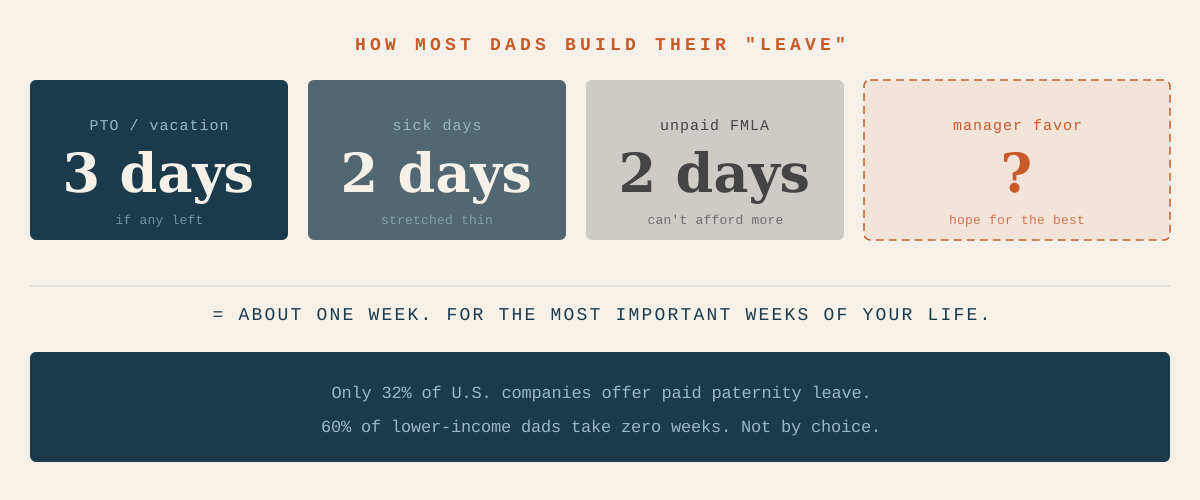
And just 32% of U.S. companies offer any paid paternity leave at all.
For low-income dads, it gets bleaker. One study found that nearly 60% of fathers in lower-income households took zero weeks of paid leave after a birth or adoption. Not a personal choice. A financial impossibility.
The average American dad who does get leave? Takes about a week.
One week. To figure out fatherhood. To learn how to hold his kid, read their cries, spell his partner through the 2am feeds, and show up as something more than a visitor in his own home.
The Census Bureau reported that about 50% of first-time fathers now take some form of paid leave – up dramatically from 23% in the late 1980s. Progress, sure. But we’re still talking about half of new dads piecing together PTO, unpaid days, and manager favors to be home for the most important weeks of their family’s life.
Why It Actually Matters (This Isn’t Just an HR Conversation)
The research on paternity leave has gotten more interesting, and more specific, than the old “bonding is good” talking points.
A 2026 study published in Translational Psychiatry tracked 25 first-time fathers through 24 weeks postpartum using brain imaging and found that the most significant neurological changes happen in the first six weeks after birth. The paternal brain isn’t just bonding emotionally – it’s physically reorganizing.
That early investment pays out for years. A study in the Journal of Marriage and Family found that fathers who took paternity leave had kids with better cognitive scores and fewer behavioral problems from preschool through early primary school – even after controlling for income, education, and other factors.
A Norwegian study found meaningful improvements in school performance at age 16 for children whose fathers took paternity leave. The bond formed in those first weeks sets a pattern – and the dads who establish themselves as equal caregivers early tend to keep that up.
And here’s the angle most HR departments should probably hear: companies that invest in parental leave and childcare see measurable gains in retention, engagement, and talent attraction.
Patagonia, which has run an on-site childcare program since 1983, estimates it recoups 91% of its childcare program costs through a combination of tax benefits, reduced turnover, and increased productivity – and turnover for parents in their childcare program runs 25% lower than the general employee population.

The Gap: What Most Dads Are Actually Doing
Here’s what the patch job looks like for most dads right now.
- FMLA covers unpaid leave – so if you can afford to go without income, you have protection. But most families can’t swing that, especially with a newborn adding new expenses.
- If you’re lucky enough to be in one of the 13 states with paid leave programs (California, New York, New Jersey, Washington, Colorado, Oregon, Connecticut, Massachusetts, Maryland, Delaware, Rhode Island, Minnesota, and Maine), you can access partial wage replacement regardless of your employer’s policy. But coverage levels and caps vary widely, and navigating the paperwork alone can be a job in itself.
- For everyone else, it’s a negotiation. PTO burned down to zero. Sick days stretched. Side arrangements with a sympathetic manager. The best case scenario for a lot of dads is two weeks stitched together from multiple buckets – and then back to work while their partner is still recovering and the baby is still waking up every two hours.
This isn’t a rant. It’s the math. And the math is why who you work for matters more than most dads realize.
The Companies Setting a New Standard
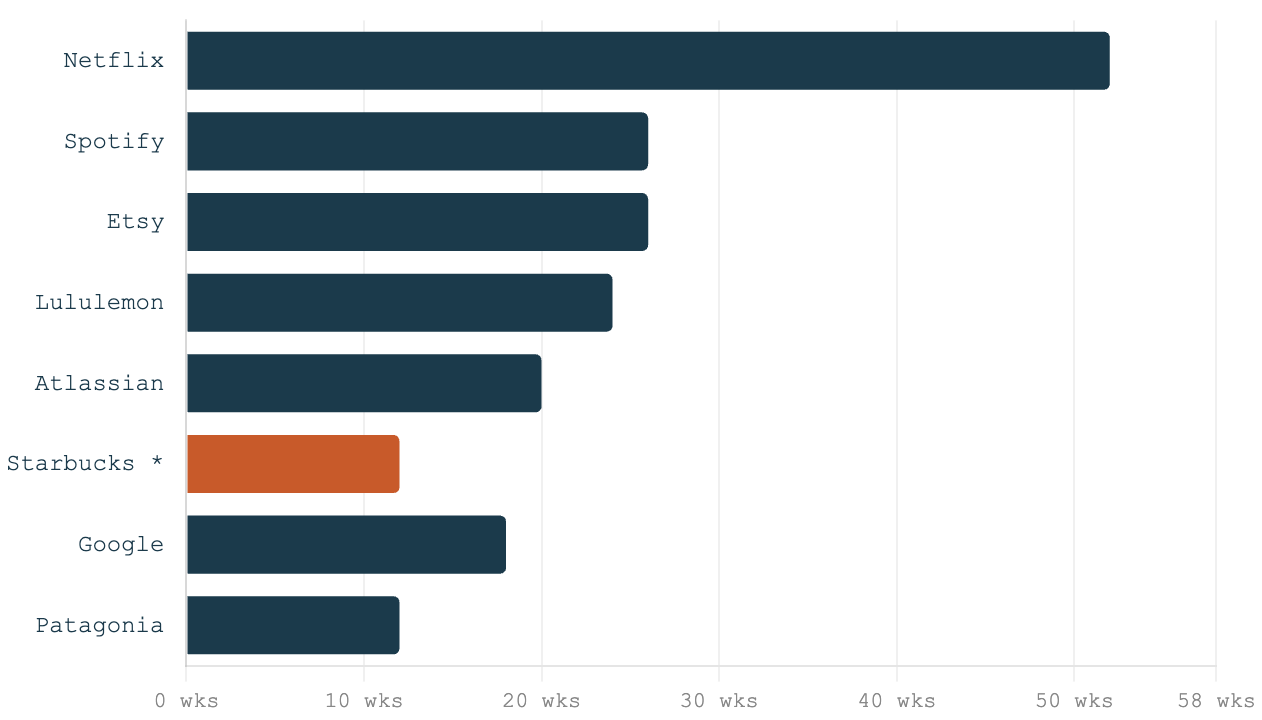
* Starbucks covers hourly partners working 20+ hrs/week. Most others are salaried employees only.
A small but growing group of employers have decided to actually do something about this. They’re worth knowing – both for the dads reading this and for any employer who wants to compete for the talent that cares about this stuff (which, increasingly, is everyone).
Netflix – Up to 52 Weeks
Netflix has long held the title of most generous in the U.S. Their policy: up to a full year of paid leave for new parents of any gender. Their official stance is essentially “take care of your baby and yourself” – most employees end up taking four to eight months. The policy applies to salaried employees and has been widely reported to be one of the main reasons top talent chooses them.
Worth noting: there was some noise in late 2024 about whether the policy was being quietly walked back, but Netflix’s Chief Talent Officer went on record saying the policy has not changed. They’ve been consistent: this is real, it’s paid, and it’s for dads too.
Spotify – 6 Months + 1 Transition Month
Spotify’s policy is built on Swedish DNA, and it shows. Every full-time Spotify employee worldwide is eligible for six months of fully paid parental leave, plus a seventh month for transitioning back. No gender qualifications. No tricks.
Their words: “Regardless of how your family is configured or your gender, if you have a baby, you can use this time in 2-month increments up until the child is 3 years old.” The U.S.-based employees have taken this benefit at strong rates – notable given that American workplace culture still tends to make men feel sheepish about actually using what they’re offered.
Etsy – 26 Weeks for All Parents
Etsy’s 26-week fully paid leave policy is gender-blind by design. When then-CEO Chad Dickerson adopted his son, he took his full leave and talked about it publicly – specifically to signal to working dads that taking leave is not something to apologize for.
The data from Etsy is remarkable: when they tracked who was using the policy, moms and dads were taking leave at nearly equal rates. Of the employees who took leave, 35% were promoted during or after. The policy is open to birth parents, adoptive parents, and parents who used surrogates.
Atlassian – 20 Weeks for Non-Birthing Parents
The Australian-American software company gives birthing parents 26 weeks and non-birthing parents 20 weeks – a meaningful number for dads. They also layer in parenting resources, behavioral and mental health support, and childcare services. Atlassian is known for being transparent about its benefits, and this policy is listed clearly on their public careers page.
Patagonia – 12 Weeks + On-Site Childcare
Patagonia has been doing this longer than almost anyone – their on-site childcare program dates back to 1983. Dads get 12 weeks of paid paternity leave, and Patagonia pays for a caregiver to accompany traveling new parents on work trips. The on-site childcare at their Ventura, CA headquarters and Reno, NV distribution center is subsidized and has been running continuously for over 40 years.
The result: 95–100% of Patagonia parents return to work after leave, compared to a national average of around 79% for mothers. The company’s argument is simple: this isn’t charity, it’s strategy. Turnover for parents with kids in the on-site program runs 25% lower than the general employee population.
Google – 18 Weeks for All Parents
Google bumped paid parental leave to 18 weeks for all parents in 2022, and up to 24 weeks for birthing parents. They also offer up to 8 weeks of paid caregiver leave annually. For a company of Google’s size and headcount, this is significant scale. They’ve also built out a gradual return-to-work program and additional transition support for new parents.
Lululemon – Up to 6 Months
Lululemon offers up to six months of paid parental leave for all types of parents – birth, adoptive, and foster. The amount of time you get scales with tenure, so long-term employees get the full benefit. Given that lululemon is a retail and athletic brand – not a tech firm – this stands out as an example of a consumer company taking the benefit seriously across its workforce.
Starbucks – 12 Weeks for Non-Birth Parents, Hourly Workers Included
This is the one that deserves special attention – not because 12 weeks is the longest number on this list, but because of who it covers. Most of the companies above are tech or professional services firms. Their “generous” policies often reach a workforce of salaried employees who already have financial cushion. Starbucks is different.
Here’s how this policy actually came to be: CEO Brian Niccol started visiting stores after taking the top job. Partners – hourly employees – told him directly that the existing leave wasn’t enough time for their families. He made the call to expand it within a week of hearing that feedback.
Starting March 2025, Starbucks more than doubled paid parental leave for U.S. store partners working an average of 20 or more hours per week. Non-birth parents – dads included – now get 12 weeks of fully paid leave. Birth parents get up to 18 weeks. This covers retail hourly workers. Baristas. Shift managers. The people who most need the income and least often have this kind of policy behind them.
Niccol put it plainly: “No other retailer offers a better parental leave benefit for new parents.”
We talked to Max, a Coffeehouse Leader who’s been with Starbucks for eight and a half years – starting as a barista, working his way up, and earning his bachelor’s degree through the Starbucks College Achievement Plan along the way. He used the parental leave benefit when his son Callan was born, and he didn’t hold back on what it actually meant.
On the first weeks home: “Weeks one through four, you’re kind of just in the trenches – blacked out, every three hours you’re changing diapers, feeding, burping, making sure he’s going back to sleep. But that next six, eight, ten weeks was really where me and Callan’s bond truly developed. We got a lot of alone time together. And it truly changes the way me and Callan are now – we’re best buddies now.”
On the financial reality: “When we were on leave, my wife and I were able to save. In April, we bought a house. It was something we didn’t even have to stress about.”
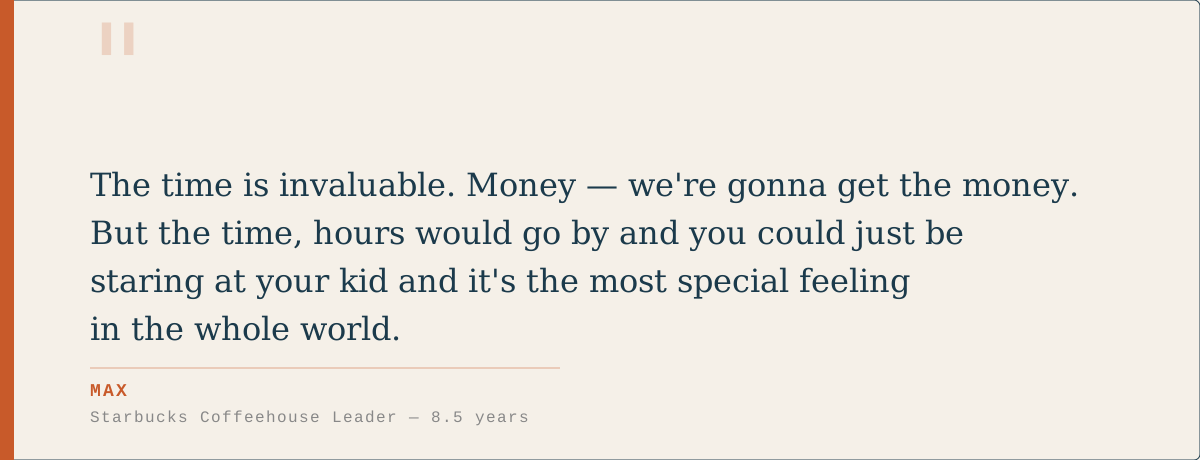
Max also mentioned something worth noting: since going through the process himself, other Starbucks partners have been reaching out to him for guidance – questions about paperwork, California disability, the logistics.
He’s become an informal resource. “Starbucks makes the process so extremely easy,” he said. “It never feels like there’s a bad time to call someone. There’s always someone there to take away the stress.”
It’s one thing for a tech company to offer six months with full pay. It’s another thing entirely when a barista working 20 hours a week can afford to be home with his newborn – and come back talking about buying a house.
Beyond Leave: What a Truly Dad-Friendly Employer Looks Like
Paternity leave duration is the headline metric, but it’s not the whole picture. And not every company has the resources to offer six months of fully paid leave – that’s reality. But weeks isn’t the only lever. The best employers stack their benefits thoughtfully.
Here’s what to look for beyond the weeks:
- Flexible and remote work. The ability to work from home, compress your schedule, or shift your hours doesn’t disappear when the baby is six months old. Ongoing flexibility matters more than most people realize going into parenthood.
- Phased return programs. Some companies – Hewlett Packard Enterprise is a notable example – let new parents work part-time for up to three years as they transition back. That ramp matters, especially in the first year.
- Childcare support. On-site centers (Patagonia, a handful of tech giants), backup care programs, or direct subsidies. The U.S. childcare system is broken. Employers who acknowledge this and help bridge the gap are operating at a different level.
- Mental health resources. New fatherhood is a significant identity shift. Companies offering EAPs, mental health platforms, or parenting support programs are acknowledging the full picture of what new parents are navigating.
- Leadership modeling. This one’s cultural, not policy. A company can have a 20-week paternity leave policy and still have a culture where no man actually takes it because no one senior has ever done so. Look for organizations where leaders – especially male leaders – visibly use parental leave. Etsy’s CEO setting the example by talking openly about his adoption leave was more powerful than the policy itself.
If You’re a Dad Navigating This Right Now
Most companies are still not on this list. Here’s how to work the system you have.
Know your FMLA rights first. If you’ve been at your job for a year and your employer has 50+ employees, you’re entitled to 12 weeks of unpaid, job-protected leave. It won’t pay the bills, but it protects your position. That’s the floor.
Check your state. If you’re in one of the 13 states with paid leave programs, you may be entitled to partial wage replacement regardless of what your employer offers. Look this up before you assume you get nothing – a lot of dads leave this money on the table.
Ask HR specific questions. Don’t just ask “what’s the paternity leave policy?” Ask: Is this available to non-birth parents? Does it apply to hourly and salaried employees equally? Can I stack PTO with leave? Is there a phased return option? The details matter, and most HR departments will answer if you ask directly.
Start the conversation early. Don’t wait until your partner is eight months pregnant to figure out your plan. The earlier you raise it, the more time you have to negotiate, plan finances, and set expectations for coverage.
Make the business case when negotiating. If you’re asking for more than what’s on paper, frame it professionally. Research what comparable companies in your industry offer. Point out retention data. Make it about value to the organization, not personal preference – even if it is both.
Plan the finances. If unpaid leave is your only option, treat it as a fixed expense and start saving six months out. Even banking three to four weeks of cushion changes the math on how much time you can actually take.
Use what you’re given. This sounds obvious, but data shows that even when paid leave exists, many dads don’t take the full amount. Workplace culture, guilt, and pressure from managers all play a role. Take the leave. It exists for a reason. The research is clear: those weeks are foundational to the kind of father you’re going to be.
The Bottom Line
We’re in an era where modern dads genuinely want to be present – from the first hours, not just the first few weekends. The culture has shifted faster than the policy. And right now, there’s a real gap between the dads we want to be and the systems we’re working inside.
Some companies are closing that gap. The ones listed here are worth knowing – whether you’re considering a job, negotiating a benefit, or making a case internally for why your workplace should do better.
Because those first weeks aren’t a perk. They’re when fatherhood actually starts.
Join the Family
Father’s Day is a good time to stop and ask the question we don’t ask enough.
Not “what are you getting for Father’s Day?” Not “what’s your parenting philosophy?” Just: what does fatherhood actually look like for you right now? The good stuff. The hard stuff. What your kids have taught you. What you’d tell a new dad if you had one minute with them.
We asked our community. Dads from across the country answered.
Here’s what they said.
The Favorite Parts
We could have predicted some of these. We couldn’t have predicted all of them.
Nick Cook from Durham, NC, a graphic designer and dad to a 2.5-year-old son, put his right at the top: “Getting to embrace my inner child and be silly with my son. His laugh is contagious.”
Devon Garcia from Portland, OR, a Solutions Engineer at Slack whose daughter is eight months old, described it as “a free jolt of pure joy and dopamine from a simple laugh.”
Same feeling. Different words. Dad after dad came back to this one. The laugh. The specific, irreplaceable laugh of your specific kid.
Casey Stevens from Columbus, OH, who has a six-year-old and two-year-old boy/girl twins, described coming home from work to “the pitter patter of tiny feet racing to the door” and hearing “Daddy’s home.” He’s not alone. That sound came up in multiple forms across the responses.
Andrew Vossler from Charleston, SC, an executive coach with four kids ranging from five months to six years, described experiencing ordinary things as brand new again: “They didn’t know churros existed. The other day we went out on a mission to find and enjoy churros. Their minds were blown.”
Austin Bergstrom from Charlotte, NC, a mortgage loan originator with a 16-month-old daughter, said it simply: “How curious she is, and how much she loves us right now. All she wants to do is be outside, play, and be around us.”
And then there’s Jon Harris from Knoxville, TN, who has a unique vantage point on the whole thing. His son is 25. His daughter is 23. His youngest daughter is 19 months old. He became a dad again at 46, and he’s not taking any of it for granted.
“Every day she learns a new word, discovers something new, or finds a reason to laugh. I don’t take any of the so-called little things for granted.”
A second chance to do it with full awareness of how fast it goes. If that’s not a Father’s Day story, we don’t know what is.
The Hard Parts
Nobody pretended it was all churros and contagious laughs.
Nick Cook went straight for it: “Potty training, hands down. It is not for the faint of heart.”
Chris Reed from Phoenix, AZ, a customer success manager with a two-year-old and another baby due in November, named what a lot of dads feel but don’t always say: “Balance and patience. I want to do the best I can in so many things, but that can cause stress that eats away at other parts of my life.”
Austin Bergstrom said it differently but landed in the same place: “Always being on the go and rarely having my own time. Every day is a constant battle of getting all my work done to be able to spend time with my wife and daughter.”
Taylor Marton from Woburn, MA, a stay-at-home dad with a three-year-old and a newborn, described “managing the intense three-year-old mood swings and not letting his emotions dictate my emotions.” Anybody who has spent time with a three-year-old knows exactly what he means.
Luke Lasiloo from Flagstaff, AZ, a warehouse manager at a food bank with a two-year-old, got honest about something a lot of dads feel but rarely say out loud: “He is really attached to mom right now and only wants mom. It hurts my soul every time. But once I rip him away and it’s just the two of us, things are fantastic. It’s a real battle to not want to check out and melt into the background.”
That last sentence. That’s the one.
Christian Thorndike from Greenville, SC, an attorney with two boys ages two and three, is currently solo parenting for five weeks due to a family medical situation: “When stress, sickness, trying to be a good parent, work, and setting boundaries all combine, it becomes a bit overwhelming. But I’d rather have the bad days with them than days without them.”
And Rob Hogan from North Georgia, a forensic accountant whose daughter is 11, described the first moment in his parenting journey where he genuinely felt out of his depth: navigating puberty with his daughter. “It doesn’t matter how many books I read or women I talk to. I will never understand the emotional and physical changes she’s going through. It’s the first time I’ve felt genuinely ill-equipped to help her.”
There’s no hack for that one. Just showing up.
Join the Family
What Their Kids Have Taught Them
This was the section we weren’t fully prepared for.
The answers came in different words. And almost all of them said the same thing. Slow down.
Taylor Marton: “They’ve taught me to slow down and not rush so much. Our society is always in such a hurry to do everything, and my toddler has really challenged me to slow down and not make everything a rush.”
Jon Harris: “My older kids taught me that the years fly by. My youngest reminds me not to rush through them. She wants to stop and look at bugs, throw rocks in the creek, and dance to the same song over and over. Most days, she’s right.”
David Case from Edmond, OK, a forklift driver with a one-year-old: “She’s taught me to slow down and enjoy the moments. To really pay attention to life’s moments.”
Christian Thorndike: “Being present and enjoying even the smallest things in life.”
Stan Navrude from Overland Park, KS, a retired pharmaceutical professional whose sons are now 34 and 30, offered the long-view version: “Patience. I find myself emulating them at times.”
Brandon Jackson from Northeast Pennsylvania, an ESG reporting controller with a two and five-year-old: “Kids are a mirror, and I need to lead by example.”
Luke Lasiloo: “Gratitude. Hearing his little voice say ‘thank you’ every time you hand him something makes you really step back and look at what’s really important.”
And Rob Hogan’s 11-year-old daughter keeps him honest in the most direct way possible: “She will call me out if I try to preach something I don’t practice or if I’m not living up to my commitments. It’s a good reminder that we are what we do, not what we say.”
Chris Reed from Phoenix distilled it to one line: “Even the simplest things can be fun and bring a smile.”
What They’d Tell a Brand New Dad
This is the part we’ll be coming back to.
Nick Cook: “Be kind to your partner, be kind to yourself. The early days are a blur, but patience, teamwork, and a sense of humor will get you through.”
Devon Garcia: “No one has it completely figured out. There’s a lot of knowledge out there, but we’re all in it together of not knowing what we’re doing. Advice is take or leave. You have to tinker and try things, and that’s the fun part.”
Chris Reed: “Find community. It’s okay to be bad at this, it’s your first time. Communicate with your partner.”
Mike Tarnovsky from Marblehead, MA, a software sales professional with a 2.5-year-old son and a 2.5-month-old daughter: “This too shall pass. No matter the hardest days you have, your kids will do the smallest thing that makes you laugh and everything is forgotten. Also, don’t forget about your wife. Get her flowers or coffee on a random day of the week. She’ll appreciate it more than you’ll ever know.”
Taylor Marton: “Give yourself, your kids, and your partner lots of grace. We are all trying to be the best parents and kids we can be. No one is perfect.”
Brandon Jackson: “The clichés are true. Enjoy the little things, they grow up fast. Give your kids, your partner, and yourself some grace.”
Casey Stevens: “The days are long but the weeks are short. Time flies. Stop to take a moment and enjoy these days.”
Christian Thorndike: “Days are long, years are short. You don’t realize when you’ve done something for the last time until it’s really gone, like rocking the kid to sleep. Don’t rush it, no matter how difficult the days are.”
Dakota Carter from Birmingham, AL, a maintenance mechanic who is raising a 14-year-old nephew and has a 13-month-old daughter: “Don’t rush anything. Don’t rush to have kids. Don’t rush through the newborn stage. Don’t rush the moments that feel insignificant. In my experience, that’s where I’ve had the best conversations.”
Andrew Vossler from Charleston said something we think every dad needs to hear: “Do it in a way that is authentic to you and your partner. And do it with a larger community. Family, friends, church, neighborhood. I believe strongly we are not designed to parent in silos.”
Jon Harris, with 25 years of fatherhood behind him and a 19-month-old in front of him: “You don’t have to be perfect. You just have to keep showing up. The ordinary moments are the ones you’ll miss the most. Be there for them.”
Rob Hogan: “Get a day planner and use it as a journal. Take a few minutes every day to jot down a couple of notes. I’ve been doing this for a while and it’s amazing to look back and see moments that made an impression at the time. I know it’s cliché to say they grow up fast, but this has been one of the best pieces of advice I’ve ever received.”
And our favorite of the whole thread, from Chris Rodinsky, a therapist in California with two kids ages one and two: “Be the pier, not the PA system. Kids and wives need somewhere safe for their emotional waves to land. Your relationship is the pier. Your voice is just the PA system. Never confuse the two.”
What We Took From All of This
Different dads. Different cities. Different jobs, different ages, different stages of the fatherhood journey from eight months in to 35 years deep.
And the through line across every single response was the same.
The little moments are the big moments. You don’t know which ones will matter until they’re gone. Slow down. Be present. Give grace to everyone in the house, including yourself.
That’s not a parenting philosophy. That’s hard-won wisdom from men who are in it every day, figuring it out in real time, doing their best with what they have.
Happy Father’s Day to every dad in this community. You’re doing better than you think!
There’s a version of your kid you’ve never met.
Not the one at the dinner table negotiating screen time. Not the one in the backseat of the minivan refereeing a sibling argument. Not the one performing for the whole family at a holiday gathering.
The one who only shows up when it’s just the two of you. Somewhere new. No agenda. No audience.
That version of your kid is worth knowing. And a solo trip is one of the fastest ways to find them.
This isn’t a new idea. But the research behind it is getting hard to ignore. And the dads who’ve done it, whether it’s a weekend camping trip with a six-year-old or a flight to somewhere meaningful with a teenager, consistently describe it as one of the best things they’ve ever done as a father.
Here’s everything you need to know.
What the Research Actually Says
One-on-one parent-child travel is officially a trend. The 2025 Hilton Trends Report found that 70% of parents of Gen Alpha kids are actively planning one-on-one travel with their children, involving them directly in destination and itinerary decisions.
But beyond the trend, the science behind why it works is solid.
Dr. Julie Cederbaum, an associate professor at USC whose work focuses on child and adolescent wellbeing, puts it plainly: “One-on-one travel, in particular, really allows for focused time with and attention to that child, increasing attachment and creating shared positive memories.”
University of Oxford research found that daughters with strong bonds to their fathers are significantly more likely to have healthier relationships with partners later in life.
University of Minnesota research confirmed that shared experiences like travel create lasting memories and strengthen emotional bonds in ways that routine daily interaction simply cannot replicate.
And on the father side?
Studies consistently show that dads benefit too. Lower stress. Higher sense of purpose. A clearer picture of who their kid actually is outside of the family system.
The mechanism isn’t complicated. When it’s just the two of you, the dynamic changes completely. There’s no partner to defer to, no siblings competing for attention, no household logistics pulling focus.
It’s just you and your kid, figuring it out together. That specific combination of shared challenge, undivided attention, and new environment accelerates bonding faster than almost anything else you can do.
Why These Trips Hit Different Than Family Vacations
Family vacations are great. We’re not arguing against them.
But here’s what happens on a family trip. You manage logistics. You negotiate between competing preferences. Someone is always tired or hungry at the wrong time. The adults end up coordinating more than connecting. The kids orbit around the family unit instead of stepping into their own.
A one-on-one trip removes all of that.
Your kid gets your full attention for the entire trip. Not shared attention. Not divided attention. Yours.
And something happens when a child realizes they have a parent entirely to themselves in a new place. They open up. They get curious. They say things they wouldn’t say at home.
One father who took his daughter to Bergen, Norway described it this way: his daughter’s confidence acted as an icebreaker, and they interacted with far more people than he would have if traveling alone. The trip changed how he saw her. And it changed how she saw herself with him.
That’s the thing nobody tells you before the first one. You don’t just learn more about your kid. You become someone different to them.
The Age-by-Age Guide
Toddlers and Early Kids (Ages 3 to 5): Keep It Close, Make It Magic
The first solo trip doesn’t need to be ambitious. At this age the magic is entirely in the fact that it’s just you two.
A one-night stay at a hotel with a pool. A train ride to a nearby city. A camping trip an hour from home. The destination is almost irrelevant. What matters is that you planned something just for them, you’re giving them your complete attention, and they get to stay up a little later than normal because the rules are different when it’s just Dad.
At this age kids are deeply present. They don’t need itineraries. They need you on the floor with them, letting them take the lead on what they want to explore next.
Keep it short. One or two nights maximum. Don’t overschedule. Build in downtime. And bring snacks. Always bring more snacks than you think you need.
What this trip does: Establishes the pattern early. Creates a reference point your kid will remember and ask to repeat. Builds trust and security in a novel environment with you as the anchor.
Elementary Age (Ages 6 to 9): The Sweet Spot
This is the golden era for dad-kid trips.
Kids this age are old enough to engage with new experiences, form real memories, and participate in the planning. They’re young enough to still be fully amazed by things. They haven’t hit the self-conscious years yet. They want to be with you.
This is the age to go somewhere that genuinely means something. A national park. A city with history they’re learning about. A sporting event for a team they love. A fishing trip. A road trip to somewhere neither of you has been.
Involve them in the planning. Ask where they want to go. Give them two or three realistic options and let them choose. Research shows these trips are enhanced specifically by the fact that kids have been involved in the planning. Ownership of the decision increases investment in the experience.
Give them a job on the trip. Navigator. Photographer. Chief snack manager. Kids this age thrive when they have a role.
Keep the schedule loose enough that you can follow their energy. If they want to spend three hours at one thing, let them. You’re not running a tour. You’re building a memory.
What this trip does: Creates some of the most vivid shared memories of their childhood. Builds confidence through navigating new environments with you. Starts a tradition they’ll want to continue as they get older.
Preteens (Ages 10 to 12): Go Somewhere That Challenges You Both
Something shifts around age ten.
Your kid is becoming a person. They have opinions, interests, and an emerging identity that’s separating from the family unit. They’re starting to care what their peers think. The window of easy access to them is narrowing.
This is the age to go somewhere that challenges you both. Not just a nice trip. An experience. A hiking trip with real elevation. A city in another country. A multi-day canoe trip. Something that puts both of you outside your comfort zones and gives you something to work through together.
Shared challenge is one of the most powerful bonding mechanisms that exists. When you and your kid are both a little uncertain, a little tired, figuring out something hard together, the relationship changes. They see you as a person, not just a parent. And they discover something about themselves they couldn’t have found in a comfortable environment.
Let them carry real responsibility on this trip. Let them navigate. Let them make some of the calls.
If something goes sideways, work through it together instead of fixing it for them. That’s where the real growth lives.
What this trip does: Deepens the relationship before the teenage years hit. Gives your kid a reference point for their own capability. Creates the kind of shared story that gets retold for decades.

Teenagers (Ages 13 to 17): This One Matters More Than You Think
A lot of dads back off during the teenage years. Kids get busy. They want their independence. It feels awkward to push for connection when the kid seems to be pushing back.
Don’t back off.
The research on father-teen relationships is consistent: teens who maintain strong bonds with their fathers show better outcomes across nearly every measure. Mental health. Academic performance. Resistance to negative peer pressure. Confidence in relationships.
And here’s what we know from talking to dads who’ve done it: the teenage years are when these trips mean the most, even when the kid acts like they don’t care.
They care.
Take them somewhere they’ve expressed genuine interest in. A city with a music scene they’re into. A country they’ve been curious about. A sporting or cultural event. Something you can both get genuinely excited about.
Drop the agenda on this one. Don’t use the trip as a vehicle for the conversations you’ve been wanting to have. Just be with them. Let the trip be the trip. The conversations will happen on their own when you’re in the right environment and neither of you is performing for anyone.
Some of the most important things a dad ever hears from his kid happen in a car, or at dinner in an unfamiliar city, or on a hike when there’s nothing else to fill the silence. Create those conditions and then let it unfold.
What this trip does: Keeps the connection alive through the hardest years. Signals to your teenager that they’re worth your individual time and attention. Creates a foundation for the adult relationship you’re going to have with them in a few years.
Join the Family
How to Actually Make It Happen
The biggest reason dads don’t do this isn’t motivation. It’s logistics. Here’s how to remove that excuse.
Pick a date before you pick a destination. Put it on the calendar first. An open “someday” trip never happens. A booked flight does.
- Start smaller than you think you need to. The first one doesn’t need to be ambitious. One night somewhere nearby. A day trip to a place they’ve been wanting to go. The point is to establish the pattern. The trips can get bigger as the tradition grows.
- Involve your kid in the planning from the start. Send them a text with two options and ask which one they want. Show them the map. Let them pick the restaurant for one dinner. Ownership creates anticipation.
- Protect it. Work will try to take this day. Something will come up. Protect it like you’d protect a client meeting. Your kid noticed you put it on the calendar. They will also notice if you cancel it.
Aim for at least once a year per kid. It doesn’t have to be exotic. It doesn’t have to be expensive. It just has to be intentional. One trip a year, solo with each kid, is one of the highest-return investments you can make in your relationship with them.
The Thing Nobody Says Out Loud
You are going to be a different dad on these trips.
Without the daily logistics, without the other kids, without the full household running in the background, you’ll find yourself more patient. More present. More genuinely curious about the kid sitting across from you.
And they will feel it.
“The dedicated time to just be together truly deepens the parent-child bond,” as one researcher put it. That’s a clinical way of saying something every dad who’s done this already knows.
You learn things about your kid on a solo trip that years of daily life never surfaces. What they’re actually thinking about. What they’re scared of. What they’re proud of. What they want. Who they’re becoming.
That knowledge changes how you parent them when you get home. It changes how you see them. And it changes how they see you.
Book the trip.
The story of Sunski didn’t start with a business plan. It started with a salsa bowl.
Tom Stewart and Michael Charley graduated in 2009, right into the teeth of a recession. No dream jobs waiting. No clear path. Just two guys with big ambitions and a product idea Tom had sketched on a napkin in high school: a ceramic bowl with a curved lip designed to keep salsa on your chip.
They went all in. Ordered 3,000 units from a manufacturer in China. Two-thirds arrived defective. They moved back home to South Philadelphia and started cold-calling retailers from the basement.
It didn’t work. By spring 2012, they had $273 left in the business account and were ready to quit.
But a few years earlier, on a surf trip to Australia, Tom had wandered into a beach shack selling off the last remaining stock of a defunct 1980s sunglass brand called Sunski. He bought a few pairs. Wore them constantly. Got compliments everywhere he went.
Then one afternoon on a beach in San Francisco, a stranger walked up and said: “Those are rad sunglasses.”
The stranger was a retail buyer. That was it.
The Book That Reframed Everything
When we sat down with Tom and Michael to film the third episode of Go West, one thing that came up early was The 4-Hour Work Week.
Not the hustle hacks. Not the outsourcing tricks. The bigger idea underneath it: that you get to design your life. That work and freedom don’t have to be in opposition. That the whole point of building something is to build it on your terms.
That landed with us. We read the same book. A lot of dads in this community did. And it shaped how Tom and Michael went about everything after Sunski took off.
They launched a Kickstarter in July 2012 with a $9,800 goal. They hit it in two days. The campaign closed at $157,000. They were suddenly, as Michael put it, “accidentally running a sunglasses company.”
The $273 Moment
There’s something about that number that sticks with us.
Not because it’s inspirational in a poster-quote kind of way. But because it’s real. Most people would have looked at $273 in the bank and called it a lesson learned. Tom and Michael looked at it and decided to try one more thing.
That’s the Go West spirit. Not recklessness. Not blind optimism. Just the refusal to quit before the last card is played.
They designed the frames themselves. Tom’s architecture background meant he could do 3D modeling. Their years of scrapping through the Salsabol failures meant they already knew how to deal with manufacturers, handle freight logistics, and move fast.
They launched. It worked. And then they had to pack 6,000 pairs of sunglasses in a rented artist’s studio in four days.
When the studio manager asked what their medium was, Tom said: “Cardboard.”
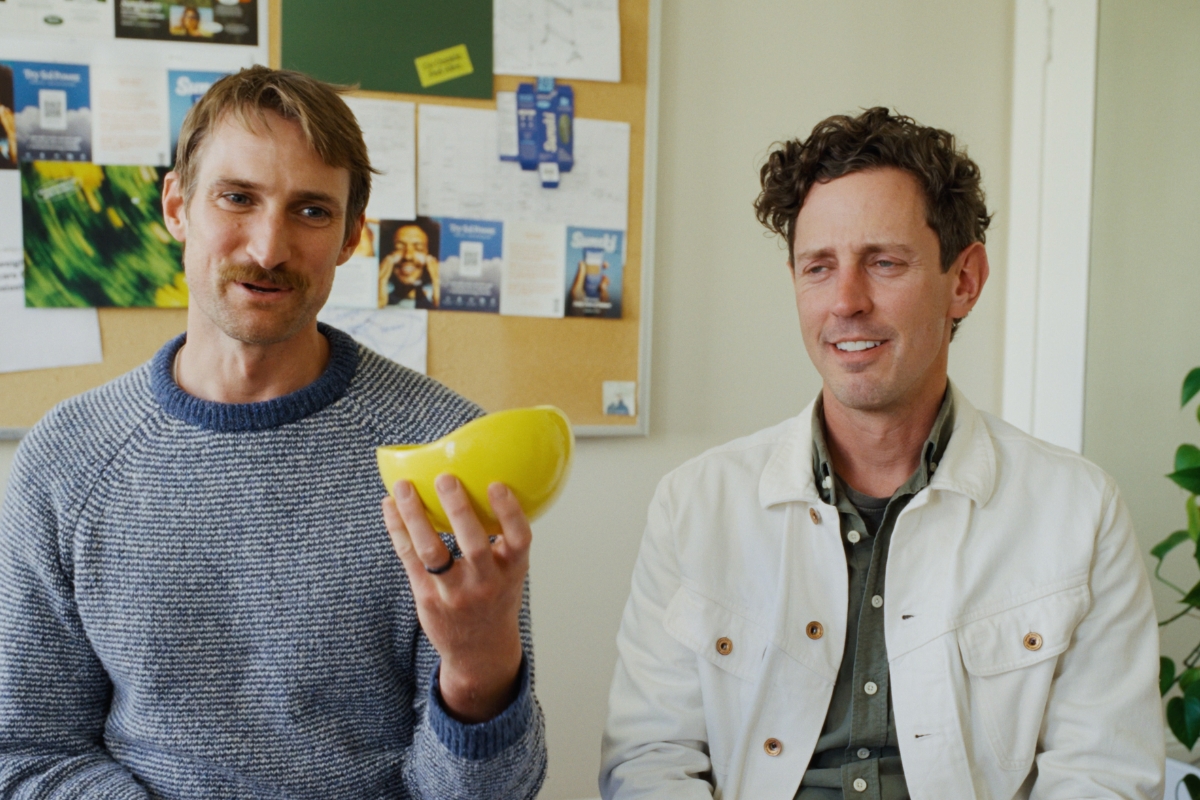
What They’re Actually Building
Here’s what makes Sunski interesting in 2026: Tom and Michael could probably exit. They’ve built a real brand, a loyal customer base, a proprietary recycled frame material they spent three and a half years developing. The outcome is there if they want it.
They’re not taking it.
Instead, they’re doubling down. Elevating the brand. Building something they believe can have long-term impact. Not just as a product, but as a statement about how a company can operate.
Part of that is sustainability. Sunski has donated 1% of revenue (not profit, revenue) to environmental non-profits since day one. Their SuperLight frames are made from post-industrial plastic scraps. This wasn’t a pivot to values. It was baked in from the start.
But the bigger thing we captured in this episode is the why behind all of it.
Screens, Nature, and the 16-Year Problem
We’re on track to spend an average of 16 years of our lives on our phones. Let that sink in for a second.
Tom and Michael brought this up on camera, and it hit hard. Because it’s not just a stat about adults. It’s a stat about what we’re modeling for our kids. About what we’re teaching them to value. About the world we’re handing them.
Both of them are fathers now. And the tension between a world pulling kids toward screens and their own instinct to push them toward nature, toward the outdoors, toward something real shapes how they think about Sunski’s purpose.
Sunglasses are a product. But what they represent is a reason to go outside. To be somewhere that matters. To be present in a way that a phone can’t give you.
Getting back to our ancestral roots, moving, being outside, paying attention to the physical world, is something both of them talk about with real conviction. Not in a preachy way. In the way dads talk when they’re actually worried about something.
The Team Is Family. They Mean It.
One more thing we captured that doesn’t always make it into founder stories:
Tom and Michael don’t take their team lightly.
Sunski has stayed small and independent. They know the people who work there. They feel the weight of that responsibility. When we asked about it, you could tell it wasn’t a talking point. It was something they carry.
That’s rare. And it’s the kind of thing that makes a brand worth rooting for.
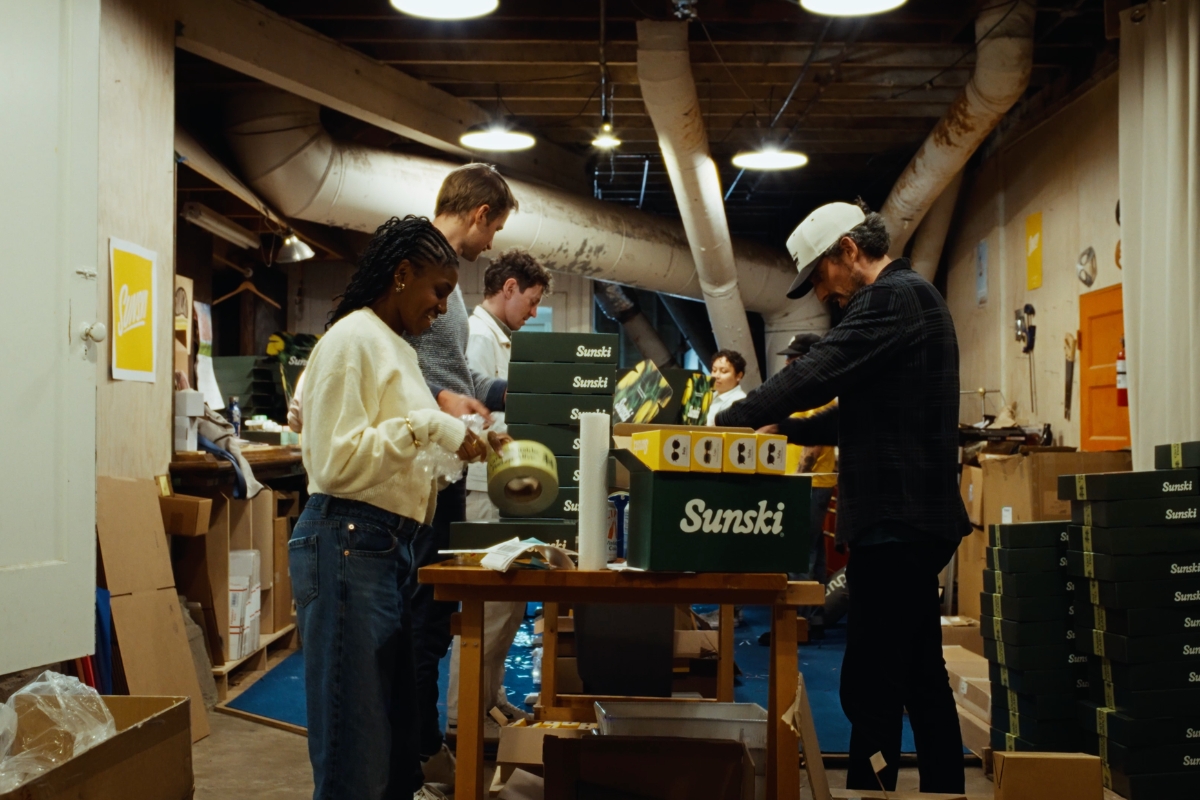
Go West, Episode 3
The film is live now. Watch it above.
Tom and Michael’s story isn’t really about sunglasses. It’s about what happens when you read a book that reframes how you think about life, fail at a salsa bowl, find a pair of vintage shades on a beach in Australia, and decide, with $273 in the bank, to try one more thing.
We think you’ll love it.
Go West is a Dad Day original series about dads carving their own path. If you know someone whose story belongs in this series, reach out at dadday.com.
Warren Buffett was selling gum door-to-door at age six. Mark Cuban started selling trash bags at twelve after asking his dad for expensive sneakers and being told they couldn’t afford them. Daymond John sold customized pencils in first grade.
IKEA founder Ingvar Kamprad was riding his bike to neighboring houses selling matches at age five, buying them in bulk and reselling them individually at a markup. Same efficiency mindset that eventually built one of the biggest companies on earth.
The pattern across the most successful people in history is remarkably consistent. And almost none of it involves elite schools, trust funds, or any particular advantage most of us don’t have access to.
It’s about a handful of deliberate habits introduced early. That’s it. Here’s what the research actually says.
They Were Given Chores. Real Ones.
This is the one that surprises people the most because it’s so unglamorous.
Harvard ran an 85-year multigenerational study tracking over 700 high achievers and found…
a strong, consistent connection between doing household chores as a kid and later professional success and life satisfaction.
Not because scrubbing a toilet teaches business strategy. But because kids who contribute to a household develop something specific: they understand they’re part of something bigger than themselves.
That builds self-worth. Work ethic. Empathy. Confidence.
A separate longitudinal study confirmed it: kids who did chores regularly in kindergarten were significantly more likely to score in the top percentiles on social competency, academic ability, peer relationships, and life satisfaction by third grade. The kids who rarely did chores? Significantly more likely to land in the bottom quintile on all of the same measures.
The key is framing. “We clean up together” lands differently than “go wash your dish.” One makes them part of the team. The other makes it feel like punishment.
Start at age three or four with simple stuff. Sort the laundry. Set the table. Pick up toys. It doesn’t need to be complicated. It just needs to be consistent and real.

They Were Taught to Fail on Purpose
Sara Blakely is the founder of Spanx and the first self-made female billionaire.
Every night at dinner her dad would ask her one question: “What did you fail at this week?”
If she hadn’t failed at anything, it meant she hadn’t tried hard enough. That reframe, repeated over years, built a relationship with failure that most adults never develop. It directly contributed to her ability to survive years of cold-call rejections before landing her first retail deal.
Bill Gates’ father had a similar approach. He encouraged Gates to do things he wasn’t good at, exposing him to failure as a learning mechanism rather than a verdict.
Stanford psychologist Carol Dweck’s research on growth mindset confirms what these parents understood intuitively.
Kids who are praised for effort and process rather than natural talent develop a belief that their abilities can grow.
She found that adding one word to a setback made a measurable difference: “You haven’t figured it out yet.” That single word changed how kids related to their own capability.
Three things you can do starting now. Praise the process, not the result. Share your own failures openly with your kids. And let them see you attempting hard things yourself, including when you struggle.
They Talked About Money Early and Often
The most iconic entrepreneurs in history were running small operations before they hit high school.
Warren Buffett bought his first stock at eleven. By thirteen he had six stocks in a portfolio. The money wasn’t the point. The practical education was. How to identify a market. How to handle rejection. How to reinvest. How to understand the relationship between effort and outcome.
Research on wealthy families shows that rich parents tend to deliberately teach financial literacy, while average families unconsciously pass down limiting beliefs about money. The gap isn’t income. It’s intentionality.
Here’s what the research says actually works. Introduce allowance around age five or six and tie part of it to contribution. Teach the save, spend, give split early. Aim for roughly 70% spend, 20% save, 10% give as a baseline. Use real transactions, grocery shopping on a budget, comparing prices, to make money concrete and not abstract.
Let kids experience the natural consequences of their spending decisions without bailing them out.
And if your kid has earned income at any age, even from a lemonade stand, you can open a custodial investment account and let them watch compound interest work in real time. That’s a lesson no classroom teaches.
They Read. A Lot. And Their Parents Made It Happen.
This one shows up everywhere.
Bill Gates has read roughly 50 books a year since childhood. Warren Buffett’s father pushed him to read widely and ask questions. Buffett now reads five to six hours a day. These aren’t coincidences. They’re habits formed early that compounded over decades.
A study of more than 10,000 young adolescents found that kids who read for pleasure early perform significantly better on cognitive tests, show better mental wellbeing, have fewer behavioral problems, and have measurably larger brain volumes in regions critical to cognitive function.
The optimal amount? Around 12 hours per week. That breaks down to less than two hours a day. That’s genuinely achievable.
Evan Williams, co-founder of Twitter, Blogger, and Medium, famously kept hundreds of physical books accessible to his young children instead of iPads. Small detail. Big signal about what he valued.
Read aloud from infancy. Create a screen-free space for reading in your home. Model it yourself. Let your kids see you reading for pleasure. Library trips where they choose their own books are underrated. Let them pick the weird one. The weird one is fine.
The Tech Founders Banned Their Own Products at Home
Steve Jobs told the New York Times in 2011 that he limited his kids’ use of the very products he was building.
Bill Gates enforced a no-phone policy for his children until age 14 after watching his daughter develop an unhealthy fixation with a video game. Wired editor Chris Anderson put parental controls and strict time limits on every device in his home.
The reasoning is consistent across all of them. They drew a line between consuming and creating. Watching YouTube is consuming. Building something, drawing something, writing something, figuring something out, that’s creating. Successful parents pushed their kids toward creation.
Elon Musk took this further. He pulled his five sons out of traditional school and founded his own on the SpaceX campus, eventually evolving it into Astra Nova. No grades. No foreign language requirement. No rote memorization. Just first-principles thinking, decision-making, and collaborative problem-solving.
You don’t need to build a school. You just need to be intentional about the difference between screen time that consumes and screen time that creates. One has a return. The other mostly doesn’t.
Join the Family
They Set High Expectations and Then Actually Helped Their Kids Meet Them
Research from Duke, UCLA, and others consistently finds that high parental expectations are among the strongest predictors of a child’s success, specifically when paired with real support to meet those expectations.
Psychologist Angela Duckworth calls this “wise parenting.” High standards plus genuine support and empathy. Not pressure without backup. Not coddling without challenge. Both at the same time.
Duckworth’s “Hard Thing Rule” is one of the most practical parenting frameworks we’ve come across.
Here’s how it works. Everyone in the family, including the parents, commits to working on one hard thing that requires practice and persistence. You cannot quit on a bad day. You see it through to a natural stopping point. And the child chooses their own hard thing, because self-selected challenges build intrinsic motivation in a way that assigned ones don’t.
The key ingredient: parents do it too. When your kid watches you train for something, learn something hard, or push through a difficult stretch in your own work, they absorb a message that no lecture can deliver. Effort and discomfort are how growth happens.
They Let Their Kids Experience Real Life Alongside Them
Jeff Bezos’ mother was a teenage parent who couldn’t afford childcare. So she brought baby Jeff with her to night school in a duffel bag packed with textbooks and baby supplies.
She wasn’t giving him a lesson. She was just living her life in front of him. And what he absorbed was what determination under constraint actually looked like in practice, not theory.
Elon Musk brings his kids to the factory floor regularly. Warren Buffett raised his children in one house their whole lives and kept things deliberately normal, famously saying his goal was to “leave them enough so they can do anything, but not so much that they can do nothing.”
The longitudinal data from the National Child Development Study is clear. Teacher-rated creativity at age seven predicted higher educational attainment and success well into adulthood.
The most creativity-stimulating environments weren’t the ones packed with enrichment activities. They were the ones where kids had space to explore, get bored, make mistakes, and figure things out.
Boredom is underrated. Let them be bored sometimes. That’s where the good stuff comes from.

They Had Real Conversations About Real Things
Research from Duke identified social skills developed early as one of the strongest predictors of long-term success.
Kids with strong social competence in kindergarten were significantly more likely to graduate from college and hold full-time jobs by age 25. The mechanism isn’t complicated.
Regular real conversation with parents, not logistical coordination about schedules and homework, but actual conversation, teaches kids how to relate to people across generations, read a room, build trust, and communicate with fluency.
Those are the same skills that determine whether someone can pitch, sell, lead, and build.
Alexis Ohanian, co-founder of Reddit, credits dinner table conversations with his father, a travel agent who started a business during the first tech boom, for showing him what the internet could actually become. Those weren’t formal lessons. They were just a dad talking about what he was seeing in his work.
That kind of access matters more than any curriculum.
One Thing the Research Got Wrong for Years
For decades the famous marshmallow test was cited as proof that a child’s ability to delay gratification predicted lifelong success.
A 2024 study following 702 participants from the original experiment into adulthood found that it wasn’t strongly predictive at all. A UCLA meta-analysis confirmed it. Once you controlled for family background and socioeconomic stability, the predictive power largely disappeared.
The real variable wasn’t willpower. It was trust in the environment. Kids who lived in stable, consistent, reliable homes waited longer for the second marshmallow because experience had taught them that waiting pays off. The people who kept their promises always came back.
The implication for dads is significant. Building a consistent, trustworthy home, one where you keep your word and expectations are clear, may do more for your child’s future than any specific activity, lesson, or curriculum you could ever introduce.
Be someone they can count on. Everything else builds on top of that.
The Short Version
None of this requires money. All of it requires intention.
Give them chores and mean it. Let them fail and reframe it. Talk about money like it’s not a secret. Read with them and in front of them. Limit passive screen time. Set high expectations and help them meet those expectations. Bring them into your real life. Have actual conversations.
And keep your word. That’s the whole playbook. It’s been working for a very long time.
Join the Family